Tag Archives: Indigenous

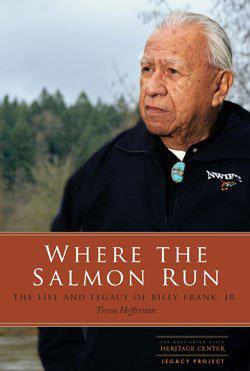
Where the Salmon Run: The Life and Legacy of Billy Frank, Jr

Helping with the proof reading of this wonderful book before it becomes ready for sale. It is amazing. I am so grateful to have the blessing of helping with the proof reading of one of my hero’s. Uncle Billy!

A Legacy Project biography of Northwest Indian activist, Billy Frank, Jr.

Please complete the form below to be notified when Where the Salmon Run: The Life and Legacy of Billy Frank, Jr. goes on sale.

Read more at https://www.sos.wa.gov/heritage/BillyFrankSignup.aspx

Marlon refuses the grammy

Raven visits with Antoinette Nora Claypoole 2-19-2012 4PM

Raven visits with Antoinette Nora Claypoole as they talk about her new book ” Ghost Rider Roads.”

In 1981, Antoinette Nora Claypoole moved from Pittsburgh, Pa. to the coast of Oregon. Born in Rochester, N.Y., as a young girl shetraveled the world. With her “army officer” parents. From Taiwan during the first wave of Americans living there in the late, 1950’s. To Sandia Base, New Mexico during Pres. Kennedy’s visit to her grade school. When she arrived as a “hippy chick”, in Oregon, she met the American Indian Movement (AIM), at a time “Indians were still being arrested in small towns”.

Working with/for Indians in AIM has informed Antoinette’s writing life and art. Her first book, Who Would Unbraid Her Hair: the legend of annie mae (1999, dist. Clear Light Books, Santa Fe, N.M.) chronicled American Indian Movement activist Anna Mae Pictou Aquash’s life, murder and legacy. The book was placed in “permanent collection” at the Smithsonian Institute, Washington, D.C. Antoinette’s poems and literary non-fiction can be found in various places: sandstone dwellings and random literary journals. Taos, New Mexico is a one of Antoinette’s special homebases, while Ashland, Oregon is her literary birthplace and has been her home since the town had dusty roads and horses riding through it.

The fellowship award from Oregon Literary Arts (Creative Non-Fiction) which Antoinette received for her upcoming work on reviving the lost works of Louise Bryant (1885-1936) reflects her ongoing commitment to unsilencing, truth. Wild Embers, her small renegade literary press, has a vow. To publish stories before they are lost. Or forgotten. Ghost Rider Roads: American Indian Movement 1971-2011 collected/by Antoinette Nora Claypoole released in Jan. 2012 is Embers recent tribute to reviving lost histories.

Antoinette Nora Claypoole
www.wildembers.com
from new book about old AIM
Ghost Rider Roads (release date Jan. 2012):

“This is a memory keeper book.

For all the reasons visionaries plant victory gardens and poets learn to hitchhike. This book emerges. A tapestry of landscape. Threads of a weave which began with the American Indian Movement (AIM) and extend into and beyond all humans pressing up against uncertainty.

Through the years defined here, via these writings, reading the entries here, the reader can feel what American Indian history of the second half of the 20th century looked like. And discover not only history, but reality, right now, which like a painted desert, sprawls through Indian Country.”

–Antoinette Nora Claypoole, from the Foreword to Ghost Rider Roads

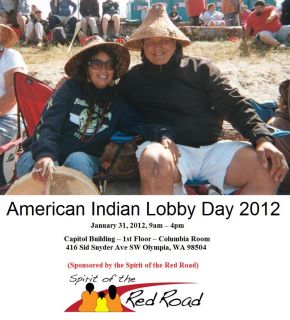
Raven visits with Robert Satiacum about American Indian Lobby Day 2012 1-29-2012 5pm

Robert Satiacum is an enrolled member of the Puyallup Tribe of Indians. He is the son of the late Chief Bob Satiacum – widely known for his sacrifices made for sovereignty and fishing rights. Satiacum is immersed his native culture, and diligently practices the traditions of the Sweat Lodge, Native American Church, and the annual Tribal Journeys in his family canoe.

Save the date!
We reserved the big room on the ground floor of the Legislative building and will make appointments for participants to meet with their legislators. Drumming in the Rotunda and on the steps of the Legislative Building are scheduled! Check back with us for details.

This Lobby Day is new, just going on it’s 2nd year, but especially important for tribal members of Washington State to solidify, and protect the rights our ancestors reserved for us, it is OUR Responsibility. We will come together at exactly the right time, with exactly the right people, doing exactly the right thing, in exactly the right place. There are Indian bills that need to be supported and testified to, and Indian bills that need to be extinguished and testified against. Our ‘Ancestors’ reserved the rights, our rights when they ceded the millions of acres full of the evergreens, and if we don’t get and be responsible, what little is left can be gone for mine, yours, and our children and our children’s children. They literally fought tooth and nail for what we have, and are observing us through the air, the water, the fire and the landscapes, waiting in anticipation for their descendants to pray, communicate, council once again together, for our sources and the future we will leave behind. We have the tools, our hearts, minds and voices, join us, this is the time! -Robert Ti Swaq Satiacum

http://www.puyalluptribalnews.com/
http://www.restorenativenames.org/
http://www.wherevent.com/detail/spirit-of-the-american-indian-lobby-day

Not only inviting you, I’m expecting you! Bring the children friends and family!

American Indian Lobby Day 2012 Agenda

Meet in Columbia Room 1st Floor – State Capitol

9:00am

Opening Prayer

10:00 am – 10:30 am

Discussing the Bills in the 2012 session that concern Indian Country
Why, and what is the importance of American Indian Lobby Day?
Learn why, how and the importance of registering to vote?
How to become Native Ambassadors to GOTV in Indian Country.

10:30 – 11:45

Feature Film Showing:

Canoe Way: The Sacred Journey
A comprehensive spiritual look at the annual international canoe journey, as the South Puget Sound (Whulge) prepares for the arrival of hundreds of canoes at host tribe: Squaxin Island Tribe of Indians

12:00 pm – 12:15 pm
Honoring State Representative John McCoy (Tulalip) D for re establishing the
Washington State Board of Geographic Names HB 1084
12:15 – 1:00pm

Drumming and sharing songs in Rotunda
Xa’Xa’ Q’uo Family/Sacred Water Canoe Family Host Drummers

1:00 pm – 2:00 pm
Meal Time in the Columbia Room / Meal Prayer
Speakers:
Christopher Winters of Native P.A.T. & Kevin Cummings of Council – Fire

2:00 pm -4:00 pm

Drumming/ Singing/Honoring, on the North Steps of the Capital Building

Open Floor (sharing your thoughts)

4:00 pm
Closing Prayer/Song
Begin work on American Indian Lobby Day 2013

Adjourned
(redbone post)

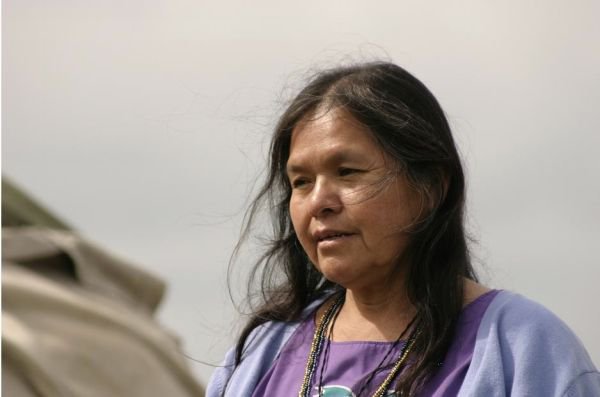
Raven visits with Grandmother Margaret Behan 1-29-2012 4pm

Description

If we want to see changes first of all we need to be in peace inside ourselves, and then we need to be patient with the ones that have not yet arrived in that place of peace.

Arapahoe-Cheyenne #003300, fourth generation of the Sand Creek Massacre. As a child, Margaret attended the Catholic Mission and Government Boarding Schools. Margaret is a Cheyenne traditional dancer. She has served as a dance leader in Oklahoma and in powwows across the U.S. A sculptress for 30 years, she creates clay figurines that have won her many honors, including shows at Eastern New Mexico University, University of Wisconsin, Santa Fe Indian Market and the Gallup Inter-Tribal Ceremonial.

Margaret is an accomplished and published author, poet and playwright. She has presented workshops and retreats for women, adult children of alcoholics and co-dependents. Margaret is currently taking an active role a leader of her tribe as a teacher of Cheyenne Culture and the President of the Cheyenne Elders Council

http://www.grandmotherscouncil.org/about-us/grandmother-bios

Raven visits with Leonard Little Finger 1-15-2012 from 4-6pm

A respected elder, Leonard Little Finger is well known for his Lakota expertise and promotion of Native American rights. He is the Founder/Director of a private Lakota language school, Sacred Hoop School, teaching in total immersion methodology. The school is dedicated …to his grandfather, a survivor of the Wounded Knee Creek Massacre of 1890.

He also operates a Lakota Culture Camp and Tours, Lakota Journey, that offers culture work shops and tours for all ages, including school camps.

He served as a Cultural Resource Specialist at Loneman School in Oglala, for 11 years. Under his leadership, the Lakota Studies program developed into one the most progressive Indian Studies program in Indian country.

Prior to this position, Little Finger was the CEO of the Pine Ridge Indian Health Service Hospital, retiring after 28 years of service for the people of the Pine Ridge Indian Reservation.

He founded a multi-year organic gardening student exchange program between Oglala Lakota College and University of Bonn, Germany. He was selected as Teacher of the Year 2000 by the South Dakota Bilingual

Education Association, and served as President of the Red Cloud Indian School Board.

Little Finger is a recognized public speaker. He has been twice a representative and presenter to the United Nations Draft Declaration for the rights of Indigenous Peoples in Geneva, Switzerland. He also spoken at Bundestag (German Parliament) in Bonn, Germany; and, at the World Parks Conference in Durbin, South Africa. In addition to appearing in several film documentaries and national radio shows, Little Finger authored the book, Lightning and Thunder Spoke to Me, an account of the repatriation of a hairlock belonging to his great-great grandfather, Sitanka, leader of the Mniconjou Band massacred at Wounded Knee Creek in 1890.

He currently resides in Oglala, SD., semi-retired, continuing his work to elevate through speaking and writings of an understanding of the culture, history, spiritual beliefs, language and inherent rights of the Lakota, The People of the Seven Council Fires, Oceti Sakowin Oyate. On May 7, 2011, Leonard was awarded an Honorary Doctorate from the College of Mount St. Joseph, Cincinnati, Ohio. In addition, he delivered the commencement address for 500 graduates. He was recognized for the many years of work in promoting the Lakota language and culture to Lakota youth, and for articulating the Lakota Mores to people throughout the world.

Beginning in the first part of 2012, free Lakota language lessons will be offered on the internet at http://www.lakotacirclevillage.org . This program will provide an understanding of Lakota Ta”Woyukcun, or Lakota Thought.

Tune in to KAOS Community Radio

2700 Evergreen Pkwy Nw – CAB 101, Olympia, WA 98505

www.kaosradio.org

New Year Day 1-1-2012 -“Prophecies and Possibilities of 2012 and Beyond” with Uncle Phil Lane Jr.

” Prophecies and Possibilities of 2012 and Beyond”, An Indigenous Perspective with Uncle Phil Lane Jr.

Chief Phil Lane Jr. is an enrolled member of the Yankton Dakota and Chickasaw First Nations and is an internationally recognized leader in human and community development. He was born at the Haskell Indian Residential School in Lawrence, Kansas in 1944, where his mother and father met and attended school. He is a citizen of both Canada and the USA.

During the past 43 years, he has worked with Indigenous peoples in North,Central and South America, Micronesia, South East Asia, India, Hawaii and Africa. He served 16 years as Associate Professor and Founder and Coordinator of the Four Worlds International Institute at the University of Lethbridge, Alberta, Canada. Four Worlds became an independent Institute in 1995. As well, Phil is Chairman of Four Directions International, an Aboriginal company, which was incorporated in 1996 as Four Worlds’ Economic Development Arm.

With Phil’s guidance and applied experience, Four Worlds has become an internationally recognized leader in human, community and organizational development because of the Institute’s unique focus on the importance of culture and spirituality in all elements of development. Four Directions International, Four World’s economic development arm, is lead by its President Deloria ManyGrey Horses, and is dedicated to the development of sustainable economic enterprises that support wholistic, political, social, cultural, environmental, spiritual and educational development.

In 1977, Phil was named a Modern Indian Sports Great by the National Indian Magazine, Wassaja, for his record-breaking accomplishments in Track and Wrestling. He has extensive experiencei n his own cultural traditions, is an award winning author and film producer and holds Master’s Degrees in Education and Public Administration. His film credits include the National Public Television series “Images of Indians” with the late Will Sampson, “Walking With Grandfather”, “The Honor of All: The Story of Alkali Lake” and “Healing the Hurts”.

In August, 1992, Phil was the first Indigenous person to win the prestigious Windstar Award, presented annually by the late John Denver and the Windstar Foundation to a global citizen whose personal and professional life exemplifies commitment to a global perspective, operates with awareness of the spiritual dimension of human existence and demonstrates concrete actions of the benefit for humans and all living systems of the Earth. At this International event, in recognition of his lineage and long time service to Indigenous peoples and the human family, Indigenous Elders from across North America recognized Phil as a Hereditary Chief through a Sacred Headdress Ceremony. Other Windstar winners include:Oceanologist Jacques-Yves Cousteau, David Brower, Founder of the Earth Island Institute, Yevgeni Velikhov, Vice President of the Soviet Academy of Sciences,Wangari Maathai, Nobel Peace Prize Winner and founder of Kenya’s Greenbelt Movement; Akio Matsumura, Executive Director of The Global Forum, and Lester Brown, President of the World Watch Institute.

On November 11, 2000, Phil received the Year 2000 award from the Foundation for Freedom and Human Rightsin Berne, Switzerland. Phil is the first North or South American person to receive the award, and he joins a select international group: the Dalai Lama ofTibet, Dr. Boutro Boutros Ghali, former Secretary General of the United Nations, and British Lord Yehudi Menuhin, musician and philosopher, have, also, received the award. The foundation says the award is in recognition of Phil’s “unique contributions to improve the lives and future hopes of Indigenous populations. It is primarily based on his most special merits of promoting freedom and justice for Indigenous Peoples by building human and spiritual capacity rather than opposing oppression directly and also on his international visionary initiatives among Indigenous populations, by healing the root causes of hopelessness and despair.”

On June 21, 2008, Phil was awarded the 14th Annual Ally Award by the Center for Healing Racism in Houston, Texas. Phil received the Ally Award for his national and international work in promoting freedom and justice for Indigenous Peoples by building human and spiritual capacity that focuses on healing the root causes of racism and oppression rather than focusing on conflict. The Ally Award is an annual award presented by the Houston-based Center for the Healing of Racism to honor the achievements of those who have worked hard to achieve harmony of all ethnic and cultural groups.

Special emphasis on this award is for Lane’s dedicated work as one of the primary leaders in the resolution of Canada’s Residential School issue, which involved the sexual, physical,cultural, psychological, and emotional abuse of thousands of Aboriginal Children in Canada. This effort resulted in a $3.5 Billion settlement for survivors, a full public apology by the Prime Minister of Canada and all Political Party Leaders on the floor of the Canadian Parliament, the establishment of a $500 million Aboriginal Healing Foundation and a formal, five year, Truth and Reconciliation Commission that is currently holding public hearings across Canada on the impact of the Residential Schools on the Aboriginal Peoples of Canada.

In 2008, Phil completed his three-year tenure as Chief Executive Officer of the United Indians of All Tribes Foundation (UIATF) in Seattle, Washington. The Foundation’s achievements include the launching of the first-ever Native American Film Festival, the development of a host of innovative education programs ranging from elementary and high school curriculum design and development, to adult education, early childhood education, and the recent launching of a $3.5 million holistic poverty-alleviation program model for urban Indigenous Peoples in Seattle.

Phil has now stepped into global leadership as Chairman of the Four Worlds International Institute (FWII) and Four Directions International. The Institute’s central program initiative is the promotion of The Fourth Way. The primary focus of The Fourth Way is to unify the human family by taking aculturally based, principal-centered path that transcends assimilation,resignation, and conflict. FWII has been working to develop a comprehensive,community-based development strategy that offers educational opportunity, IC3 Global Digital Literacy Certification, Deep Social Networks (DSN), and Social Media Training through a global networking initiative called “Indig.e.Net.”This digitally-based, globally unifying Indigenous communications and educational initiative, to be established at the Ciudad Del Saber in Panama City, Panama in 2011 will serve as one of the key components for implementing The Fourth Way across the Americas.

As well, over the past five years, Phil and the FWII DSN Team, led by Deloria Many Grey Horses, have been building DSN’s and implementing the Fourth Way across ASEAN ( SE Asia ) with a focus on Ethnic Minorities and Human Rights.

Thisinitiative is funded by the Canadian International Development Agency.

HERIDITARYCHIEF PHIL LANE JR.

Phil Lane Jr. is an enrolled member of the Yankton Dakota and Chickasaw First Nations and is an internationally recognized leader in human and community development. He was born at the Haskell Indian Residential School in Lawrence, Kansas in 1944, where his mother and father met and ttended school. He is a citizen of both Canada and the USA.

During the past 43 years, he has worked with Indigenous peoples in North,Central and South America, Micronesia, South East Asia, India, Hawaii and Africa. He served 16 years as Associate Professor and Founder and Coordinator of the Four Worlds International Institute at the University of Lethbridge, Alberta, Canada. Four Worlds became an independent Institute in 1995. As well, Phil is Chairman of Four Directions International, an Aboriginal company, which was incorporated in 1996 as Four Worlds’ Economic Development Arm.

With Phil’s guidance and applied experience, Four Worlds has become an internationally recognized leader in human, community and organizational
development because of the Institute’s unique focus on the importance ofculture and spirituality in all elements of development. Four Directions International, the Institute economic development arm, is lead by its President Deloria ManyGrey Horses, and is dedicated to the development of sustainable economic enterprises that support holistic, political, social, cultural, environmental,spiritual and educational development.

In 1977, Phil was named a Modern Indian Sports Great by the National Indian Magazine, Wassaja, for his record-breaking accomplishments in Track and Wrestling. He has extensive experience in his own cultural traditions, is an award winning author and film producer and holds Master’s Degrees in Education and Public Administration. His film credits include the National Public Television series “Images of Indians” with the late Will Sampson, “Walking With Grandfather”, “The Honor of All: The Story of Alkali Lake” and “Healing the Hurts”.

In August, 1992, Phil was the first Indigenous person to win the prestigious Windstar Award, presented annually by the late John Denver and the Windstar Foundation to a global citizen whose personal and professional life exemplifies commitment to a global perspective, operates with awareness of the spiritual dimension of human existence and demonstrates concrete actions of the benefit for humans and all living systems of the Earth. At this International event, in recognition of his lineage and long time service to Indigenous peoples and the human family, Indigenous Elders from across North America recognized Phil as a Hereditary Chief through a Sacred Headdress Ceremony. Other Windstar winners include:Oceanologist Jacques-Yves Cousteau, David Brower, Founder of the Earth Island Institute, Yevgeni Velikhov, Vice President of the Soviet Academy of Sciences,Wangari Maathai, Nobel Peace Prize Winner and founder of Kenya’s Greenbelt Movement; Akio Matsumura, Executive Director of The Global Forum, and Lester Brown, President of the World Watch Institute.

On November 11, 2000, Phil received the Year 2000 award from the Foundation for Freedom and Human Rights in Berne, Switzerland. Phil is the first North or South American person to receive the award, and he joins a select international group: the Dalai Lama of Tibet, Dr. Boutro Boutros Ghali, former Secretary General of the United Nations, and British Lord Yehudi Menuhin, musician and philosopher, have, also,received the award. The foundation says the award is in recognition of Phil’s”unique contributions to improve the lives and future hopes of native populations. It is primarily based on his most special merits of promoting freedom and justice for indigenous people by building human and spiritual capacity rather than opposing oppression directly and also on his international visionary initiatives among Native populations by healing the root causes of hopelessness and despair.”

On June 21,2008, Phil was awarded the 14th Annual Ally Award by the Center for Healing Racism in Houston, Texas. Phil received the Ally Award for his national and international work in promoting freedom and justice for Indigenous Peoples by building human and spiritual capacity that focuses on healing the root causes of racism and oppression rather than focusing on conflict. The Ally Award is an annual award presented by the Houston-based Center for the Healing of Racism to honor the achievements of those who have worked hard to achieve harmony of all ethnic and cultural groups. Special emphasis on this award is for Lane’s dedicated work as one of the primary leaders in the resolution of Canada’s Residential School issue, which involved the sexual, physical,cultural, psychological, and emotional abuse of thousands of Aboriginal People sin Canada. This effort resulted in a $3.5 Billion settlement for survivors, a full public apology by the Prime Minister of Canada and all Political Party Leaders on the floor of the Canadian Parliament, the establishment of a $500 million Aboriginal Healing Foundation and a formal, five year, Truth and Reconciliation Commission that is currently holding public hearings across Canada on the-impact of the Residential Schools on the Aboriginal Peoples of Canada.

In 2008,Phil completed his three-year tenure as Chief Executive Officer of the United Indians of All Tribes Foundation (UIATF) in Seattle, Washington. The-foundation’s achievements include the launching of the first-ever Native American Film Festival, the development of a host of innovative education programs ranging from elementary and high school curriculum design and development, to adult education, early childhood education, and the recent launching of a $3.5 million holistic poverty-alleviation program model for urban Indigenous Peoples in Seattle.

Phil has now stepped into global leadership as Chairman of the Four Worlds International Institute (FWII) and Four Directions International. The Institute’s central program initiative is the promotion of The Fourth Way. The primary focus of The Fourth Way is to unify the human family by taking a culturally based, principal-centered path that transcends assimilation,resignation, and conflict. FWII has been working to develop a comprehensive,community-based development strategy that offers educational opportunity, IC3Global Digital Literacy Certification, Deep Social Networks (DSN), and Social Media Training through a global networking initiative called “Indig.e.Net.”This digitally-based, globally unifying Indigenous communications ande ducational initiative, to be established at the Ciudad Del Saber in Panama City, Panama in 2010, will serve as one of the key components for implementing The Fourth Way across the Americas.

As well, over the past five years, Phil and his DSN SEARCH Team, led by Deloria Many Grey Horses, have been building DSN’s and implementing the Fourth Way across ASEAN ( SE Asia ) with a focus on Ethnic Minorities and Human Rights.

This initiative is funded by the Canadian International Development Agency.

Grandmother Mona Polacca speaks on responding to the call for Humanity. 12/18/2011 at 5PM

Mona Polacca
Hopi/Havasupai/Tewa Arizona

Grandmother Mona Polacca believes that her origins are as important as her name, Polacca, which means ‘the butterfly’ in the Hopi language. In Hopi Iore, the butterfly symbolizes man’s spiritual transformation. On her father’s side, she is a Hopi-Tewa form the Sun and Tabacco Clans. On her mother’s side, Grandmother Mona is Havasupai, the people of the Blue Green Water, form the Grand Canyon area in Arizona…

Mona’s maternal grandfather and great-grandfather were the last chiefs of the Havasupai Nation. She believes their prayers helped make a way for her in this world.

Grandmother Mona lives her life according to her mother’s teaching and takes great care with her speech and actions. “You are not here just for yourself, Grandmother Mona’s mother taught her. Wherever you go, you are a representative of our family Âlour tribe, our people.”

For almost 30 years, Grandmother Mona Polacca has worked in the field of alcoholism and substance abuse. In the 1970s she was given the job to develop substance-abuse programs for tribal youth. She organized inside her culture with youth programs led by elders who shared traditions and life stories. Kids learned traditional songs and games that give them a greater sense of identity, purpose, and direction.

Soon the young people became involved in running the conferences. The youth learn these ways are accessible. Not meant to be just seen under glass in a museum where you can only stand and look, Grandmother Mona says. “Their hands can hold the traditional ways. It’s not just our history, but an essential part of our life today.”

Grandmother Mona has helped several important studies about addictive behavior. One study reveals that the most important way for Native women to overcome substance abuse is the threat of taking away their children. Another study proves that Native youth respond positively to programs with cultural components like sweat lodges, singing, and drumming. Even those living far from their reservations can maintain sobriety through a close connection with the ceremonies.

Today Grandmother Mona lives in Arizona and has a son, two daughters, and seven grandchildren. She is now working on her Ph.D. at the Interdisciplinary Justice Studies Department of Arizona State University. When Grandmother Mona first addressed the Grandmothers Council, she embraced them as beautiful relatives of the world. She then explained that the Hopi way of greeting those from other nations is to reach out an open hand to show one has come in peace.

INTERNATIONAL COUNCIL OF THIRTEEN INDIGENOUS GRANDMOTHERS

For the Next 7 Generations

Grandmother Mona

Aside

Raven Redbone | “Make No Bones About It” RavenRedbone| “Make No Bones  About It”  by Robert Humes RavenRedbone hosts  the “Make No Bone sAbout It” show Sundays from 4- 6 pm on 89.3 FM KAOS Radio. For many of us, … Continue reading

Jennifer Jessum filmmaker shares on KAOS 89.3 FM Holy Man is the story of Douglas White- Sunday, November 13 · 5:00pm – 6:00pm

JENNIFER JESSUM & SIMON JOSEPH (www.holymanfilm.com)
Holy Man is the story of Douglas White, an 88 year old Lakota wicasa wakan or medicine man from Pine Ridge Lakota Reservation in South Dakota, who spent 17 years in federal prison for a crime he did not commit. During the making of this film, filmmakers uncovered new evidence of White’s innocence and brought the case back to Federal Court.

Jennifer Jessum

www.HolyManFilm.com

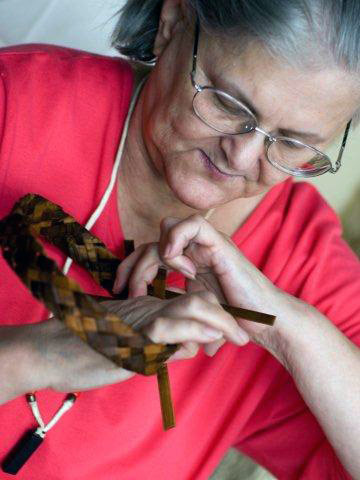
Lois Thadei Mater Aleut Weaver Today 10-9-2011 at 4pm

Lois Chichinoff Thadei is a master Aleut weaver. Aleut weavers of the Aleutian Islands have harvested, processed, prepared, and woven objects with fine natural grasses from these islands for centuries. Thadei was introduced to methods of this traditional art in a residential boarding school in Minnesota. She shared and learned cultural information there, often at night and in secret, with the possibility of being punished if she was discovered. She and others wove stitches underneath their blankets, if only to enjoy them for a few moments before they would rip them apart to avoid being punished. Thadei believes this experience taught her to make quick, certain movements, and to make each one count. Despite the cultural trauma and many other challenges faced by Thadei, her strong, unyielding passion to learn the art of Aleut weaving prevailed.

She has received many awards and honors for her work; including winning second place in woven regalia for a cedar rain hat in 1998 from Northwest Indian Art, second prize in basketry for a cedar utility basket in 1999 from Northwest Indian Art, and an award for a cedar utility basket in 2000 from the Urban Indian Art Show in Tacoma. Her art has been featured in exhibits in Russia, Oregon, and Washington. She was also invited to the Washington State Lt. Governor’s 2007 show at the Washington State capitol. Lois has also won a fellowship from the First Peoples Fund in 1999 and a First Peoples Fund Cultural Capital Fellowship, which allowed her to document Aleut weavings in private collections in Washington.

Thadei believes that this artistic tradition is a necessity for the well-being of her community. Grass woven products were used for many different objects with many different purposes including insulation, decoration, and cooking. Weavers wove the spirit of themselves and their communities into their works. These works are snapshots of history and the voices of past generations speaking to present and future generations.

As a recipient of the 2009 Apprenticeship grant, Thadei will teach the art of Aleut weaving to Shannon Huber. Huber was chosen because she has a passion for learning the art and a determination to constantly improve upon her weaving techniques. She also has a great willingness to teach others the skills she has learned. Thadei will be teaching Huber to work with both waxed linen and coastal grasses that are cured over the course of six to eight weeks. She will also teach her dyeing and the stories about and history of Aleut weaving. This will help Huber and others ultimately identify the strength of and pride in their culture through these baskets.

Huber has been exposed to Aleut folk art throughout her life. Her maternal great grandmother was a basket weaver and another ancestor told her stories of Anfesia Shapsnikoff, a well known Aleut weaver. It was difficult for Huber to find a teacher in the continental United States because Aleutian basket weaving is an uncommon art in this area. After searching for ten years, Huber found Thadei, or “Auntie Louie”. After this apprenticeship, Huber plans on researching local museums for Aleut art. She also wants to strengthen the weaving community by connecting Aleut weavers with weaving students. Both Thadei and Huber believe that teaching this tradition will again tie together younger and older members to learn, share, and connect through the art.

Thadei and Huber plan a public presentation in either Olympia or Tacoma next winter as a part of the project ”Elder’s Whisper”, which documents some of the older Aleut weavings that are part of private collections in Washington State.

http://www.arts.wa.gov/folk-arts/master-artists/thadei.shtml
Traditional Aleut hat, woven by Lois Thadei

“Weaving is the core of my creative expression,” Lois said. “Guided by ancient hands and echoes of voices recently passed, I manipulate materials – the pieces determine their own dimension and form. I offer only the hands, while others are the heart and soul of my work. Printmaking is the documentation of my life experience, and that which I remember of my ancestors. If I keep telling the story, someone will remember and we will not be forgotten.”