Remembering Billy Frank Jr. _ Northwest Indian Fisheries Commission

“We’re all going to miss this great man,” Squaxin Island tribal chairman David Lopeman said. “I always considered him chief — chief of all of us.”

Remembering Billy Frank Jr. _ Northwest Indian Fisheries Commission#more-906

 
Friends and family members recalled those quotes during the late Nisqually leader’s funeral service Sunday at the Little Creek Casino Resort’s Event Center near Shelton.

Funeral services for Billy Frank Jr.

Thousands pay tribute to Billy Frank Jr. — activist, environmental giant, leader, friend

 384-1diRX9_AuSt_38

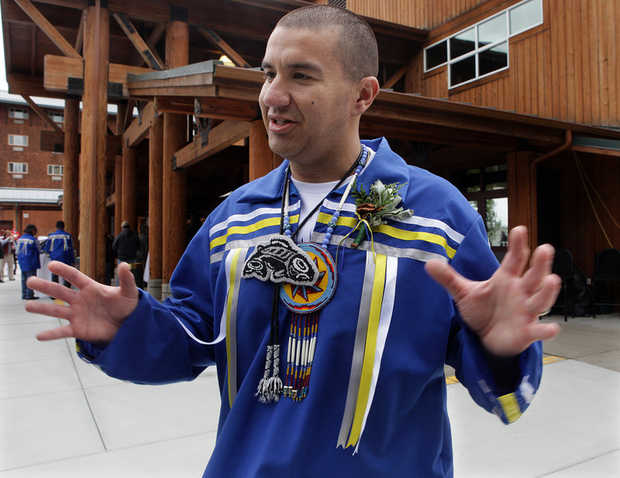
Saying,”His legacy is going to live on until the end of time,” Willie Frank recalls his father, Billy Frank Jr. at a May 11th public memorial at the Little Creek Casino honoring the environmental and native fishing rights champion who passed away May 5th. An overflow audience estimated at 6,000 filled the Squaxin Island Events Center along with adjacent portable tents and nearby hotel rooms to honor the 83 year-old Nisqually tribal elder and chairman of the Northwest Indian Fisheries Commission. Speakers included Gov. Jay Inslee. U.S. Senators Patty Murray and Maria Cantwell and Squaxin Island Tribe Chairman David Lopeman. STEVE BLOOM — The Olympian

By Lisa Pemberton
Shelton — There were stories, prayers and songs. And there were a few cuss words sprinkled in — largely for effect — because it’s hard to talk about the legacy and life of Billy Frank Jr. without mentioning his famous “Jesus Christ!” greeting, or “Who the hell is in charge here?” Friends and family members recalled those quotes during the late Nisqually leader’s funeral service Sunday at the Little Creek Casino Resort’s Event Center near Shelton. “We’re all going to miss this great man,” Squaxin Island tribal chairman David Lopeman said. “I always considered him chief — chief of all of us.”Frank, longtime chairman of the Northwest Indian Fisheries Commission, died May 5 at age 83. He was a central figure in the Indian fish-ins during the 1960s and ’70s that led to the court ruling known as the Boldt decision. The case affirmed 20 coastal and Western Washington treaty tribes’ rights to 50 percent of harvestable salmon.“His legacy is going to live on until the end of time,” Frank’s son Willie Frank told The Olympian just before the service. “He wouldn’t want the tears and all of that. He’d want us looking for the future.”An estimated 6,000 people attended the service — the largest turnout for an event in the resort’s history, according to Little Creek spokesman Greg Fritz. In addition to filling the event center, crowds also watched the service on jumbo screens from a large tent and other areas of the resort. The service featured traditional Indian Shaker Church prayers, a presentation of a folded U.S. flag for the family — Frank had served in the Marine Corps — and remarks from more than 20 tribal leaders and elected officials. “I often said that no one cared more about salmon and the planet Earth than our friend Billy,” said former U.S. Rep. Norm Dicks. Gov. Jay Inslee described Frank as a state and national leader. “When Billy Frank spoke, people listened,” he said. Frank was born and raised on the Nisqually River. “That river flowed through his veins and gave him strength,” said Swinomish tribal chairman Brian Cladoosby, who is president of the National Congress of American Indians. Frank was arrested more than 50 times during the fish wars. “He taught us that we have to take care of the salmon; they are a tribe too,” Lopeman said in an interview with The Olympian prior to the service. “Each run is a tribe. He taught a lot of us that.” U.S. Sen. Patty Murray said she’ll remember Frank being “full of fight, full of joy and full of life.” U.S. Sen. Maria Cantwell described him as “a legend that has walked among us,” and she compared his legacy to those of Cesar Chavez, Martin Luther King Jr. and Nelson Mandela. Cantwell recalled inviting Frank to conduct a blessing ceremony of her office when she was newly elected. After learning the cleansing would involve burning ceremonial sage, she told him she was nervous about security issues on the nation’s capitol. “He said, ‘Getting arrested? That’s something I know how to do well,’ ” Cantwell said with a laugh. Cladoosby described Frank as a teacher, a truth teller and a rebel rouser. He said Frank also was a mentor for many tribal leaders, and a family man who spent his life fighting to protect the Nisqually River.“Billy treated everyone with respect, even when we failed to live up to his expectations,” Cladoosby said. “Billy also showed us how to cuss with class. You can’t really talk about Billy without mentioning cussing. He’s the only one who could swear and make it sound like a Hallmark card.”Quinault Indian Nation President Fawn Sharp referred to Frank as “a historic visionary.”Over the years, they attended many meetings together. Frank knew the treaty language by heart and often said their work was about preserving the way of their ancestors while protecting tribal rights and natural resources for the next seven generations, she said.When Frank spoke, “it was something that ignited your heart, and your mind,” Sharp said. “You wanted to go out to battle that day.”

Read more here: http://www.thenewstribune.com/2014/05/11/3191155/remembering-billy-frank-jr-activist.html?sp=/99/289/&ihp=1#storylink=cpy

Services planned for Billy Frank Jr.

2023539301

Services planned for Billy Frank Jr.
May 7th, 2014

Funeral services for Billy Frank Jr. will be held 10 a.m. Sunday, May 11 in the Squaxin Island Tribe’s event center at the Little Creek Casino Resort, 91 W State Route 108, Shelton.

 He will be interred at the Chief Leschi Cemetery, 2249 Reservation Road, just north of the ballfields. A dinner will follow at the Squaxin Tribe’s event center.

A public viewing will be held on Saturday, May 10 from noon to 5 p.m. at Mills and Mills Funeral Home, 5725 Littlerock Road SW, Tumwater.

Donations are being accepted by the Northwest Indian Fisheries Commission for the Billy Frank Services Fund. Send donations to the NWIFC, 6730 Martin Way E., Olympia, Wash. 98516.

Donations can also be made to the Billy Frank Jr. Salmon Forever Fund in care of Salmon Defense, PO Box 7431, Olympia, Wash. An online memorial to the life and legacy of Billy Frank Jr. is available at billyfrankjr.org

Services planned for Billy Frank Jr. _ Northwest Indian Fisheries Commission

The life and legacy of Billy Frank Jr.


Billy Frank Jr.: National Treasure of the Pacific Northwest and the World

Honoring the Sacred in Central Park: Blessing Our Mother Earth and the Horse Nation. May 10th, 2014

The Evergreen State College Spring Traditional POW-WOW

FLYER

The Evergreen State

College Spring

Traditional POWWOW

MAY 24th GRAND ENTRIES AT 1pm & 7pm

Emcee – Arnold Littlehead

Arena Director – Larry Cordier

Head Woman Dancer – Elena Santistevan

Head Man Dancer – Melvin Blacketer

Host Drum – Young Society

Invited Drums – Indian Heritage Singers

Little Battle – Rockin Horse – Spearfish

Sound by Randy Vendiola

SPECIALS – Hand Drum – Iron Woman & Man

Brought to you by The Native Student Alliance – The Evergreen

State College – TESC Longhouse – Student Activities – Abolish Cops

And Prisons – MEXA de Evergreen – The Flaming Eggplant Café

Contact: 360 867 5367 – evergreen.nsa@hotmail.com – vendors: stefweber@gmail.com

Flyer

Raven visits with Many Hands as he shares with us about The Many Hands Community Outreach Programs. April 20, 2014 at 4pm

40951_428554288395_1942679_n

The Founder of Many Hands Community, David Many Hands Maloney, will join us to share about the programs offered through this unique local outreach project.

The Many Hands Community includes a land stewardship program and the Many Hands Community School (MHCS); a year-round program involving children, parents, & community members in education & multi-cultural programs, recreation, community improvement, & service activities. Incorporating elements of Social and Emotional Learning, Life-role Education and Community Awareness, education through Peace Village Curriculum, the traditional wisdom and the applied spirituality of the Native American Sacred Hoop teachings, this community offers a wealth of resources.

Bio:
David “Many Hands” Maloney

Currently, David is the President of Peace Village board of directors, the Founder, Executive Director and Manager of ‘Many Hands Community’ non-profit organization and teacher of Circles of Change curriculum at the Network Charter School.

David presently develops and coordinates community assistance and service learning opportunities. He is a dedicated educator with elementary, high school and university teaching experience, as well as experience in curriculum development. Thus far, he has been responsible as the Executive Director for the majority of the effort in establishing Many Hands Community non-profit: for the organization, structure, site development, and documentation. He holds a BA in Psychology and a Masters in Education in Counseling, Family and Human Services. He also holds a Not-For-Profit certificate from the Department of Planning, Public Policy & Management at the University of Oregon.

http://manyhandscommunity.com/?page_id=22

Chief Phil Lane Jr and Faith Spotted Eagle -Message to Obama – Reject and Protect. April 20th, 2014 at 5pm

ChiefPhil

Chief Phil Lane Jr and Faith Spotted Eagle in Ottawa on March 20. Photo courtesy of Rueben George

Pipeline Fighters Unite to Protect Future Generation’s Water and Land
Message to Obama – Reject and Protect.

Oceti Sakowin Territory – Just three days before the U.S. Department of State’s public comment period ended on the TransCanada’s Keystone XL Pipeline Project (KXL), Pipeline Fighters and Water Protectors from across South Dakota and Nebraska gathered for a meeting in Winner, SD, hosted by the Ihanktonwan Treaty Council and the Brave Heart Society to discuss direct-action campaign strategies that will include grassroots spiritual camps along the Keystone XL corridor, as well as a National event to be held the third week of April, 2014, with the message to President Obama – “Reject and Protect”.

Tribal members of the Oceti Sakowin, along with allies discussed how to heighten awareness of the catastrophic danger that the monstrous KXL Pipeline will not only have on the water, which will be non-reversible damage, but to the entire Midwest, known to most Americans as the Bread Basket of America.

The proposed 1,700 mile TransCanada’s Keystone XL will pump the dirtiest, highly toxic oil from the tar sands in Canada, going directly over the north-east portion of the Ogallala Aquifer, which is the largest fresh water aquifer in the United States and provides water to ranches, farms, towns and cities from South Dakota all the way to Texas. This pipeline will stretch from the Canadian border, through the Dakotas and the Sand Hills of Nebraska and all the way to the oil refineries in Texas, owned by the Koch Brothers, who also have shares in TransCanada.

Chief Arvol Looking Horse, 19th Keeper of the Sacred White Buffalo Calf Pipe, offered the opening prayers at the meeting and provided encouragement to continue the unification of all people to stop the desecration of Mother Earth. “My heart is heavy, the Water of life – Mini Wiconi is speaking to us through our ceremonies and many people are having dreams. As I hear the Voices standing up against the destruction of Grandmother Earth, I realize we need to stand in Unity to protect the Water of Life,” Looking Horse said.

It is the position of the Pipeline Fighters and Water Protectors that the KXL poses a direct threat of major water contamination along this route. There are also twenty-two rivers that are in the direct path of the KXL. “They will go approximately twenty-five feet below the bedrock of these rivers,” said John Harter, one of the local ranchers. In addition, numerous other water sources, such as wells and tributaries will also be affected when the KXL leaks or breaks.

The impact to Native species along the route were also discussed and how the building of the KXL will affect the precious ecosystem, already stressed from past years droughts, such as migratory birds like the Sand Crane in Nebraska. “We witnessed the Sand Cranes coming to greet us when we had our first spiritual camp in Ponca, Neb.” Said Aldo Seoane, Oyate Wahacanka Woecun.

Jane Kleeb of Bold Nebraska spoke about the Washington DC action that took place in front of the White House on Sunday March 2nd, where 300 individuals were arrested opposing the proposed Keystone XL Pipeline. Kleeb stressed the need to have focused, unified, direct action campaigns opposing the pipeline, showing unity between the landowners and local tribes.

“Our ranching and farming families have a tradition of protecting their neighbors. If a fence is down, your neighbors are right there helping you. That is why the Cowboy and Indian Alliance is strong. We are neighbors with shared values of protecting our land and water for future generations. We are proud people and we will stop this pipeline.” Kleeb said.

Meeting organizer, Faith Spotted Eagle, Protect the Sacred and the Brave Heart Society, focused discussion on upcoming spiritual camps that each of the tribes agreed to hold on their respective reservations and close as possible to the KXL corridor. “We need to pursue a unified message and approach for all allies, including media strategies, and Indigenized Consultations Standards as an act of sovereignty,” she said.

Another major concern is TransCanada’s plans to set up several “man camps” along the KXL route. One of the camps is sited to be built in Opal, SD, where it was reported that there may be up to 1,500 men in one camp. “This is a form of militarism, bringing in these man camps,” said Spotted Eagle. “For those of us who have the history, it smacks of repetitive economics, when they put us in forts and they wanted our land. All we’re willing to do here is sell our soul, just for the economy. That’s the dark side.”

The group discussed dates and locations for where some of the encampments may be held and will coordinate media updates to notify the public when the spiritual camps will be occupied. Treaty elder advisors explained protocol to be in place for organizing the upcoming actions. Protect the Sacred will be offering some resources for spiritual camp organizing for those grassroots communities in the direct path of the KXL.

Gary Dorr of Oyate Wahacanka Woecun (Shielding the People) spoke about camp specifics and strategies to ensure that the overall message of solidarity against the pipeline was heard. Oglala Sioux tribal representatives also pledged support for the camps, along with Rosebud Sioux Tribe. The Cheyenne River Sioux Tribal officials were not in attendance; however their official Tribal resolution opposing the Keystone XL Pipeline was presented to organizers.

Rebecca Tobias, Director of the Raoul Wallenberg Institute of Ethics, cited a need to involve the international communities. Tobias arranged for a question and answer session with an international law firm. One of the key topics of the session was the need for the national and international communities to acknowledge the validity of the treaties between the United States and tribes. Tobias challenged the public to become aware of how, “the government can acknowledge the NAFTA (The North American Free Trade Agreement) and follow it to a ‘T’ but fail to acknowledge the treaties signed between the US government and federally recognized tribes?”

The majority of the Oceti Sakowin stands strong with a message of No KXL in Treaty Territory and will continue to protect their historical treaty lands, sacred sites and sacred species. The 1980 United States Supreme Court ruled that the Treaty is the “Supreme Law of the Land” and the Tribes have been steadfast for the United States to honor the treaties, which can help protect all those living within the treaty boundaries their inherent right to clean drinking water, now and for future generations.

Carla Rae Marshall, a member of the Cheyenne River Sioux Tribe and Protect the Sacred media coordinator said, “I believe this (KXL) is not just an environmental issue, it is also a human rights issue, and it doesn’t seem that TransCanada, or the U.S. politicians that are for the building of this pipeline care about our water being contaminated. Water is life, and without water there is no life. Why don’t they understand that?”

The Brave Heart Society and Ihanktonwan Treaty Committee would like to thank the following organizations for attending: Wolakota-World Peace and Prayer Day, Oyate Wahacanka Woecun, Oglala Sioux Tribe, Bold Nebraska, 350.org, Dakota Rural Action-Nebraska Chapter, Cowboy Indian Alliance, White Buffalo Calf Woman Society, Domestic Violence Prevention Initiative of RST, Raoul Wallenberg Institute of Ethics, members of the Oceti Sakowin, concerned land owners, ranchers and citizens. They also would like to thank all those who are committed to standing up for our future generations and look forward to more organizations, tribes and citizens joining in these unified efforts to stop TransCanada’s Keystone XL pipeline and the Tar Sands.

Please watch for further updates via social media and/or at the following websites: http://www.boldnebraska.org, http://www.protectthesacred.org or http://www.shieldthepeople.org .

Contact:

Jane Kleeb, Bold Nebraska – jane.kleeb@gmail.com

Gary Dorr, Oyate Wahacanka Woecun – Shielding the People – gfdorr@gmail.com

Carla Rae Marshall, Protect the Sacred – tipistola@gmail.com

Billy Frank Jr, Hank Adams and Willie Frank III on KAOS 89.3 fm, April 20th, 2014 at 6pm

1514536_10203289161887977_1456390092_n

Left to Right

Billy Frank Jr and Hank Adams

I tell my people get ready. That guy, the salmon, he’s coming back.” – Billy Frank Jr.

Decades ago, in a far different America, salmon wars erupted on Northwest rivers. Unknown tribal members held up Indian treaties and took a stand for fishing rights. One was a Nisqually Indian named Billy Frank. “I wasn’t the Billy Frank that I am now,” the Nisqually tribal leader told reporters in 1984. “I was a bitter person.” Says friend Tom Keefe, “When I look at Billy Frank, and I guess I know more about him than most people, I can say there is a guy who decided that he could change the world by changing himself.”


American of the past sixty years. From his mediation of disputes between the US government and AIM in the 1970s to his key role in the Trail of Broken Treaties, Adams shaped modern Native activism. For the first time Adams’ writings are collected, providing a well-rounded portrait of this important figure and a firsthand history of Indian country in the late twentieth century.


Why Billy’s strategist Hank Adams is “The Most Important Indian”

You could never run out of adjectives describing Hank Adams. The Assiniboine Sioux is uncommonly gifted and marvelously complex. He is as elusive as he is loyal—and rarely without sarcasm. Though few outsiders grasp his role, Adams’s mark is everywhere in Indian Country, from its seminal events to its most obscure. Billy’s friend for a half century, Adams has played a central character at every turn in the Nisqually elder’s life. Hank was the one “making sure you understood that there was a problem,” muses Dan Evans, former governor, of their respective roles in the divisive fish wars. “And Billy was the guy who very quickly started to say, ‘This isn’t working. We’ve got to find a better answer.”

 tribe_gift

Willie Frank; Billy Frank Jr.; and Fran Wilshusen at the Nisqually Tribe’s charitable event. Photo by Peggan Hines


Willie brings extensive tribal governance experience to his role as a Councilmember. A graduate of Evergreen State College’s Native American Studies program, Willie plans to use his education to work for and with tribal members to plan future growth and development.

Coming Back: Restoring the Skokomish Watershed .


Members of the Skokomish Watershed Action Team have been collaborating for a decade on how to best restore the Skokomish watershed, located at the southern end of Hood Canal, in western Washington. From federal agencies to the Skokomish Tribe to private citizens, this is the story of how these very different groups have worked to restore the river after decades of logging and development in the area.