Tag Archives: Connecting with Spirit

Jeff Dickison from Squaxin Island Tribe talks about Restoring the estuary.


Join Raven and his guest Jeff Dickison from Squaxin as they visit about Restoring the estuary and helping heal the water ways. Sunday, June 26 · 4:00pm – 6:00pm

“The Deschutes River has the potential to be a much more ecologically rich place than it is today,” said Dickison. “Wilder and White clearly had more respect for salmon than the people that dammed the Deschutes River, creating Capitol Lake. The original designers obviously designed the original reflecting pool in the context of the natural environment.”

Questions & Answers

What is the difference between a lake and an estuary?
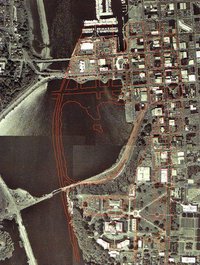
Actually, Capitol Lake isn’t really a lake at all, but a shallow reservoir created by damming the Deschutes River. In 1951, the state government built the 5th Avenue dam, blocking the Deschutes River and creating Capitol Lake.

An estuary is a biologically rich environment where a river reaches salt water. Estuaries play an important role in the lives of several species, including birds and fish. Salmon depend on estuaries for vital rearing and feeding habitat. Salmon are born in freshwater, and as they move downstream they undergo a physiological change which enables them to live in saltwater. Estuaries are the first place salmon encounter saltwater and it is important that there be enough food and habitat.

Currently, the Deschutes estuary does not exist. It has been inundated by the impoundment created in the 50s. The 5th Avenue dam blocks off any meaningful interaction between salt and freshwater that defines an estuary.

Won’t draining Capitol Lake leave a big mud hole?
Restoring the Deschutes estuary won’t really “drain” Capitol Lake. Actually, most people won’t notice a difference. Most of the time, the northern basin, or the “reflecting pool,” will not look any different than it does today. Natural tidal movement will fill the lower basin “reflecting pool” almost 80 percent of the time.

Only the southern two basins will see significant drainage, but even those will be filled as they are now during high tide. By restoring the Deschutes estuary, it is possible to retain the reflecting pool aspects of Capitol Lake.

Won’t an estuary be smelly?
No, the historic smell of the former estuary was caused by untreated sewage that was dumped directly into the Deschutes estuary. Raw sewage, not the periodic exposure of mudflats by the tides, caused an intense aroma that some still associate with the original estuary. Wastewater is now treated in Olympia before it is dumped into Budd Inlet.

Isn’t it possible to have clean water and a lake?
Virtually all of the water quality issues associated with Capitol Lake exist because it is an impounded river. Invasive species, drawn to Capitol Lake’s warm, shallow and stagnant environment are taking over the lake.

During the summer, nitrogen and phosphorous build up in the lake, depriving it of oxygen, which is vital to a healthy ecosystem. A recent report by the Washington Department of Ecology states that restoring the Deschutes Estuary would solve many of the water quality problems associated with Capitol Lake (link: http://www.scribd.com/doc/11615221/CLAMP-110608-Deschutes-Handouts).

Choosing to continue maintaining Capitol Lake is choosing to live with future water quality problems.

What will restoring the estuary do to wildlife?
Restoring the estuary will benefit native species while removing many invasive species. Capitol Lake already supports a large community of wildlife and plants, but these are not species native to our area, and have gained a foothold in Capitol Lake because it is an artificial landscape (link: http://www.scribd.com/doc/5528143/CLAMPSC090408A2).

The Puget Sound Partnership has identified eradicating invasive species like the ones that live in Capitol Lake as a high priority to restoring the entire Puget Sound ecosystem (link: http://www.psparchives.com/our_work/protect_habitat/ans.htm). As it is now, Capitol Lake is a haven for invasive species.

Isn’t Capitol Lake part of the “vision” of the Capitol Campus?
No. When the architects Walter Wilder and Harry White designed the Capitol Campus, the lake was more than forty years off and their plan specifically called for a free flowing Deschutes River (link). Their vision of a reflecting pool would have entailed diking off a portion of what is now the eastern part of Capitol Lake’s north basin to create a saltwater reflecting pool. Rather than being a shallow and warm freshwater impoundment, that reflecting pool would have been routinely flushed by the tides.

The real reason behind the creation of Capitol Lake wasn’t to complete the original “Wilder and White” vision, but rather to change the image of the nearby neighborhood. Up until the early 1940s, what is now Capitol Lake was home to a shanty town called “Little Hollywood.” In 1941 Little Hollywood was dismantled and burned, and ten years later the state completed the permanent flooding of the site.

Will we be cut off from the shoreline
because of concerns of protecting the estuary?
No, while the landscape of the shoreline and uses will change, access will not be impacted. Some uses, such as recreational fishing, could improve. For example, many other local estuaries – like Kennedy Creek at Totten Inlet – are popular sport fishing sites at low tide.

Can we cheaply dredge the lake?
Dredging Capitol Lake is an expensive solution to a problem that will never be solved without allowing the original estuary to be restored. All of the sediment carried by the Deschutes River is now deposited into Capitol Lake, slowing filling it up. Estuaries, because of their tidal influence, naturally disperse sediment into the marine environment. But, because the Deschutes River is dammed, the sediment has nowhere to go.

Dredging will be a multi-million dollar undertaking each time and it only solves one problem associated with the damning of the Deschutes. Water quality, invasive species, and other problems will continue to exist even with an expensive, aggressive dredging plan.

Is this part of a radical plan to return the entire area to a pristine state?Absolutely not. One of the important things to remember that restoring the Deschutes River estuary won’t and can’t be a total restoration of the local ecosystem. Too many things – from filling in nearby tidelands to urban development – have happened and there is no reasonable way to turn back the clock.

Restoring the estuary is a simple, sensible step to restoring as much of function of the local eco-system as we can.

Jeff Dickison, Policy Analyst, Squaxin Island Tribe, (360) 432-3815, jdickison@squaxin.nsn.us

LINKS:
http://www.squaxinisland.org/deschutes/milfoil.html
http://www.squaxinisland.org/deschutes/free_flowing.html


The Signs Are Clear and Everywhere! The Time of Fulfillment and Unified Action is Now!

Raven visits with Chief Phil Lane Jr. -The Signs Are Clear and Everywhere! The Time of Fulfillment and Unified Action is Now! June 19th, 2011 from 4pm-6pm

Bio:
Chief Phil Lane Jr
Hereditary Chief Phil Lane Jr. is an enrolled member of the Yankton Dakota and Chickasaw First Nations and is an internationally recognized leader in human and community development. He was born at the Haskell Indian Residential School in Lawrence, Kansas in 1944. He is a citizen of both Canada and the USA and was on the IILG agenda in both 2009 and 2010.

Sunday’s from 4-6 pm only on KAOS 89.3 FM

Sunday’s from 4-6 pm only on KAOS 89.3 FM

Tune in each week………..

New format coming…..

Wisdom Quote:
“So let us unite spiritually, All Nations, All Faiths, One Prayer. ”

– Chief Arvol Looking Horse

An Evening with Ernie LaPointe May 8th, 2011 on KAOS 89.3 FM

Ernie LaPointe was born in 1948 on the Pine Ridge Reservation in South Dakota. He grew up in Rapid City, South Dakota with his half-sister Marlene Little Spotted Horse. Their late mother Angelique LaPointe Spotted Horse was a housewife. His late father Claude LaPointe farmed in Pine Ridge and worked in a lumber yard in Rapid City.Ernie attended the public school system in Rapid City. When he was 10 years old, his mother died of cancer. At age 17 his father died of a heart attack. He lived with his (half) Sister Marlene until he was 18 and old enough to join the military. He was stationed in Korea, Turkey, and Germany, and all over the United States. Mr. LaPointe did one tour in Vietnam in 1970-71. He received an honorable discharge from the Army in 1972.

On his Mother’s side he is the Great Grandson of Sitting Bull and Seen By Her Nation Woman. Mr. LaPointe can point out a long line of chiefs on his Mother’s as well as on his Father’s side. His Grandfather, Spotted Horse was the son of Hunts Enemy and the Grandson of Chief Charging Bear. His Great Grandmother’s (Tokala Win LaPointe) brother was Chief Painted Horse.

Mr. LaPointe met his wife, Sonja, at a pow wow in Rapid City, SD; they will be married for 13 years in April 2008. Mr. LaPointe is a Sun Dancer and lives the traditional way of the Lakota and follows the rules of the sacred pipe.

http://finland.usembassy.gov/root/pdfs/native_american_history_and_culture3.pdf

Water Walkers in Olympia 2011 -Stayed Tune

Chief Arvol Looking Horse

Join Raven and his guest Chief Arvol Looking Horse on May 1, 2011. Tune in at 5pm. -International World Peace and Prayer Day 2011

Join Raven and his guest Chief Arvol Looking Horse on May 1, 2011.  Tune in at 5pm.

“All Nations, All Faiths, One Prayer” is respecting each other’s traditions, culture and religions.

There is one Creator and one grandmother earth that we all share. We have gone all over the world once a year to pray with other Indigenous nations at their Sacred Sites and to the United Nations to talk about prophecies. We as the First Nations have committed ourselves to maintaining our sacred way of life. -Chief Arvol Looking Horse

Pilamaya (thank you) for supporting this effort for Peace and the protection of our Grandmother Earth and her Sacred Sites. We will be united in prayer with Chief Arvol Looking Horse message of peace. I have contacted Wolakota to let them know we will be hosting and event and following the prayer and join in the sacred fire, offering tobacco to united all our prayers.

All Nations, All Faiths, One Prayer!

http://www.wolakota.org/wppd.html

page of the event:
http://www.worldpeaceandprayerday2011.org/Home_Page.php

poster:
Submitted by:

Sheldon Peters Wolfchild

Join Raven and his guest Deborah Guerrero

Join Raven and his guest Deborah Guerrero when they talk about Stand For Peace in Olympia Washington–Sunrise October 7th to October 11th, 2011

Deborah J. Guerrero MSW (Tlingit, Snohomish, & Cowlitz) is a social worker at Muckleshoot Indian Child Welfare in Auburn Washington. She is an activist and community organizer. She serves as a Board of Director for several Indian Organizations in Seattle.

She is a ceremonialist and has a deep passion for Traditional Indigenous Healing ways. She is an active member in the Native American Church, and is the proud parent of three grown children. She is a co-founder of Turtle Women Rising.

Turtle Women Rising invites you to support this Stand For Peace in Olympia.
http://www.turtlewomenrising.com/about-us.php

A Visit with Chief Phil Lane Jr. -Sunday, April 17 · 5:00pm – 6:00pm

About Phil

BRIEF RESUME- PHIL LANE JR.
Phil Lane Jr. is an enrolled member of the Yankton Dakota and Chickasaw First Nations and is an internationally recognized leader in human and community development. He was born at the Haskell Indian Residential School in Lawrence, Kansas in 1944, where his mother and father met and attended school. He is a citizen of both Canada and the USA.

…During the past 43 years, he has worked with Indigenous peoples in North, Central and South America, Micronesia, South East Asia, India, Hawaii and Africa. He served 16 years as Associate Professor and Founder and Coordinator of the Four Worlds International Institute at the University of Lethbridge, Alberta, Canada. Four Worlds became an independent Institute in 1995. As well, Phil is Chairman of Four Directions International, an Aboriginal company, which was incorporated in 1996 as Four Worlds’ Economic Development Arm.

With Phil’s guidance and applied experience, Four Worlds has become an internationally recognized leader in human, community and organizational development because of the Institute’s unique focus on the importance of culture and spirituality in all elements of development. Four Directions International, the Institute’s economic development arm, is lead by its President Deloria Many Grey Horses, and is dedicated to the development of sustainable economic enterprises that support wholistic, political, social, cultural, environmental, spiritual and educational development.

In 1977, Phil was named a Modern Indian Sports Great by the National Indian Magazine, Wassaja, for his record-breaking accomplishments in Track and Wrestling. He has extensive experience in his own cultural traditions, is an award winning author and film producer and holds Master’s Degrees in Education and Public Administration. His film credits include the National Public Television series “Images of Indians” with the late Will Sampson, “Walking With Grandfather”, “The Honor of All: The Story of Alkali Lake” and “Healing the Hurts”.

In August, 1992, Phil was the first Indigenous person to win the prestigious Windstar Award, presented annually by the late John Denver and the Windstar Foundation to a global citizen whose personal and professional life exemplifies commitment to a global perspective, operates with awareness of the spiritual dimension of human existence and demonstrates concrete actions of the benefit for humans and all living systems of the Earth. At this International event, in recognition of his lineage and long time service to Indigenous peoples and the human family, Indigenous Elders from across North America recognized Phil as a Hereditary Chief through a Sacred Headdress Ceremony. Other Windstar winners include: Oceanologist Jacques-Yves Cousteau, David Brower, Founder of the Earth Island Institute, Yevgeni Velikhov, Vice President of the Soviet Academy of Sciences, Wangari Maathai, Nobel Peace Prize Winner and founder of Kenya’s Greenbelt Movement; Akio Matsumura, Executive Director of The Global Forum, and Lester Brown, President of the World Watch Institute.

On November 11, 2000, Phil received the Year 2000 award from the Foundation for Freedom and Human Rights in Berne, Switzerland. Phil is the first North or South American person to receive the award, and he joins a select international group: the Dalai Lama of Tibet, Dr. Boutro Boutros Ghali, former Secretary General of the United Nations, and British Lord Yehudi Menuhin, musician and philosopher, have, also, received the award. The foundation says the award is in recognition of Phil’s “unique contributions to improve the lives and future hopes of native populations. It is primarily based on his most special merits of promoting freedom and justice for indigenous people by building human and spiritual capacity rather than opposing oppression directly and also on his international visionary initiatives among Native populations by healing the root causes of hopelessness and despair.”

On June 21, 2008, Phil was awarded the 14th Annual Ally Award by the Center for Healing Racism in Houston, Texas. Phil received the Ally Award for his national and international work in promoting freedom and justice for Indigenous Peoples by building human and spiritual capacity that focuses on healing the root causes of racism and oppression rather than focusing on conflict. The Ally Award is an annual award presented by the Houston-based Center for the Healing of Racism to honor the achievements of those who have worked hard to achieve harmony of all ethnic and cultural groups. Special emphasis on this award is for Lane’s dedicated work as one of the primary leaders in the resolution of Canada’s Residential School issue, which involved the sexual, physical, cultural, psychological, and emotional abuse of thousands of Aboriginal Peoples in Canada.

In 2008, Phil completed his three-year tenure as Chief Executive Officer of the United Indians of All Tribes Foundation (UIATF) in Seattle, Washington. The Foundation’s achievements include the launching of the first-ever Native American Film Festival, the development of a host of innovative education programs ranging from elementary and high school curriculum design and development, to adult education, early childhood education, and the recent launching of a $3.5 million holistic poverty-alleviation program model for urban Indigenous Peoples in Seattle.

Phil has now stepped into global leadership as Chairman of the Four Worlds International Institute (FWII) and Four Directions International. The Institute’s central program initiative is the promotion of The Fourth Way. The primary focus of The Fourth Way is to unify the human family by taking a culturally based, principal-centered path that transcends assimilation, resignation, and conflict. FWII has been working to develop a comprehensive, community-based development strategy that offers educational opportunity, IC3 Global Digital Literacy Certification, Digital Social Networking Capacity, and Participatory Media Training through a global networking initiative called “Indig.e.Net.” This digitally-based, globally unifying Indigenous communications and educational initiative, to be established at the Ciudad del Saber in Panama City, Panama in 2010, will serve as one of the key components for implementing The Fourth Way.

Red Nation Music Fest 2011