THURSDAY, NOVEMBER 14th
2:00-3:30pm
Tillman Chapel
Church Center for the United Nations
777 UN Plaza at 44th Street
New York, New York
Chief Arvol Looking Horse, 19th Generation Keeper of the
Sacred White Buffalo Calf Pipe and Spiritual Leader of the Great Sioux Nation, will present the Council Statement on Fukushima.
Please bring your voice, your vision and your prayers!
“We are the People of the Earth united under the Creator’s Law with a sacred covenant to protect and a responsibility to extend Life for all future generations. We are expressing deep concern for our shared future and urge everyone to awaken spiritually. We must work in unity to help Mother Earth heal so that she can bring back balance and harmony for all her children.”
The Kogi from Columbia traveled and brought a message: The temple of life is now broken, we must awaken and stand for life, because the Chief of Chaos is now reigning. No longer is it just in our communities, it has spread in our water of l…ife, in our sacred air and broken our Mother Earth. People have come to a place of not caring and wanting to go out…
I think all people better pay attention, because no one is exempt, I still believe we as humans can make a change “All Nations, All Faiths, One Prayer”.
Nov. 8th Tepco will begin moving over 1000 dangerous fuel rods, many giving their lives to do it. 2001 WPPD statement ending from Chief Arvol Looking Horse, I think it fits this terrible scenario we are ALL facing about Fukashima: “You must decide. You can’t avoid it. Each of us is put here in this time and this place to personally decide the future of humankind. Did you think the Creator would create unnecessary people in a time of such terrible danger? Know that you yourself are essential to this World. Believe that! Understand both the blessing and the burden of that. You yourself are desperately needed to save the soul of this World. Did you think you were put here for something less?” Below informational utube of what we are facing and the Elders statement. COUNCIL FUKUSHIMA STATEMENT OCT 2013
SUNDAY Only on KAOS 89.3 FM. 4:30PM PACIFIC
MAKE NO BONES ABOUT IT.
Representatives of the Council
Chief Arvol Looking Horse
19th Generation Keeper of the Sacred White Buffalo Calf Pipe Spiritual Leader
The Great Sioux Nation aka Pte Oyate Buffalo People
Bobby C. Billie
Clan Leader and Spiritual Leader
Council of the Original Miccosukee
Simanolee Nation Aboriginal Peoples
We are now at the Crossroads, please share Urgent
Nov. 8th Tepco will begin moving over 1000 dangerous fuel rods, many giving their lives to do it. 2001 WPPD statement ending from Chief Arvol Looking Horse, I think it fits this terrible scenario we are ALL facing about Fukashima: “You must decide. You can’t avoid it. Each of us is put here in this time and this place to personally decide the future of humankind. Did you think the Creator would create unnecessary people in a time of such terrible danger? Know that you yourself are essential to this World. Believe that! Understand both the blessing and the burden of that. You yourself are desperately needed to save the soul of this World. Did you think you were put here for something less?”
Sarah James, a Gwichin elder from Arctic Village, Alaska, is the board chair and a spokesperson for the Gwichin Steering Committee, and has educated people around the world about the porcupine-caribou herd and the importance of protecting the Sacred Place where Life Begins (the Arctic National Wildlife Refuge) from oil exploration and drilling. She has received many awards, including the prestigious Goldman Environmental Prize, the National Conservation Land Trust Award and the Ecotrust Award for Indigenous Leadership.
Oren R. Lyons is a traditional Faithkeeper of the Turtle Clan, and a member of the Onondoga Nation Council of Chiefs of the Six Nations of the Iroquois Confederacy (the Haudenosaunee).
Lyons graduated from Syracuse University with a degree in Fine Arts and soon moved to New York City, where he worked for Norcross Greeting Cards. He started as a paste-up artist but later became an art and planning director for Norcross. His background in art has helped him become an accomplished illustrator of books and a …painter.
In 1970, Lyons returned to his ancestral homeland in upstate New York to act as Faithkeeper of the Turtle Clan. In this capacity, he is entrusted with keeping alive his people’s traditions, values and history.
Oren Lyons is Associate Professor at SUNY (University at Buffalo), in the Center for the Americas. He teaches courses on Native American history and studies, and advises graduate students. Prof. Lyons also appears at many conferences and meetings, speaking on American Indian topics, human rights, interfaith dialogue, and the environment.
Aside from his work at the University and the Turtle Clan, Lyons is the co-founder of the national American Indian quarterly news magazine Daybreak, of which he has been the publisher since 1987. He also edited the book Exiled In The Land Of The Free: Democracy, The Iroquois and The Constitution (1992) , a major study of the Indian’s impact on American democracy and the United States Constitution.
An essay from Oren Lyons, “Our Mother Earth,” is included in Seeing God Everywhere: Essays on Nature and the Sacred .
The images of full blood Cherokee artist, Donald Vann, speak of peace and tranquility of solitude. They speak of yesterday’s tradition and tomorrow’s promise. Through his work, Donald takes the viewer to a place that is as real to him as the tangible world. To see his paintings is to feel the crunch of snow beneath one’s feet, to hear the wind whisper through the aspen trees and to smell the wood smoke and buffalo of hide tipis. It is to know the soft-spoken man behind the paper and paint. Donald Vann
“All my life,” Donald explains, “I have had this desire to paint with images I can express thoughts and feelings I could never put into words. Through my art I am able to transcend the limitations of the spoken word.”
It is more than just his Native American heritage that Donald strives to share. Warriors on horseback, a medicine man greeting the dawn and young maidens gathering wood are only the means of conveying moods that are much more universal. He uses those images to tell how he feels about the unseen forces that influence life. Donald draws his greatest inspiration from the earth, sky, and from the rhythms of nature. His creations have a quality that allow the viewer to share some of the inner facets of the Indian soul. “In our world, there is an unspoken quality, a feeling that touches and flows through everything … all of us as well as all things of the earth. If one listens to these forces, he will find himself painting instinctively with the feeling of his heart about his ancestral beliefs and the way people live today.”
These spiritual elements have been a part of his life for as long as he can remember. “Growing up I was always a loner.” Donald recalls, “I spent a lot of time hunting, but that was really just a way of being by myself out of doors. That is where I felt the most comfortable and in tune with the natural spirits evident in all things.”
When he wasn’t camping with his grandfather or hunting in the woods near his boyhood home outside Stilwell, Oklahoma, Donald remembers painting. “I didn’t fit in too well at school, the one art class I took, I flunked. I always thought education got in the way of learning. I was much more interested in the teachings of the holy man for my clan and in the survival and herb skills my grandparents taught me.”
Combining his love for art and his Cherokee heritage, Donald is able to create moving images that speak of the Indian way of life and capture the hearts of art collectors worldwide. He is recognized for his haunting images of his people’s heritage, especially his portrayal of the Trail of Tears. He was proclaimed “one of the best known Indian artists of the 20th century” by the Cherokee National Historical Society. The Smithsonian Institution’s Museum of the American Indian honored him with their top painting award for watercolor medium. He has also won first place ribbons in juried competitions at Oklahoma’s Red Earth Exhibit, Colorado Indian Market and National American Indian Arts Exposition.
More than 50 different editions of his signed and numbered prints are now collectors items. He has taken top honors at shows from Texas to Ohio, and Minnesota to North Carolina. Yet, it is the public’s acceptance is what matters most to Donald.
“Through my images,” Donald says when asked of his success, “I hope people will be inspired to learn more about the customs and values of America’s native people. Our traditions teach many things that can help all people. In today’s fast-paced world, it is too easy to get cut off from one’s heritage and lose sight of the things that are truly important. If I can make people see with their hearts instead of their eyes, then my art has spoken. Then I have succeeded.” http://www.donaldvann.com/
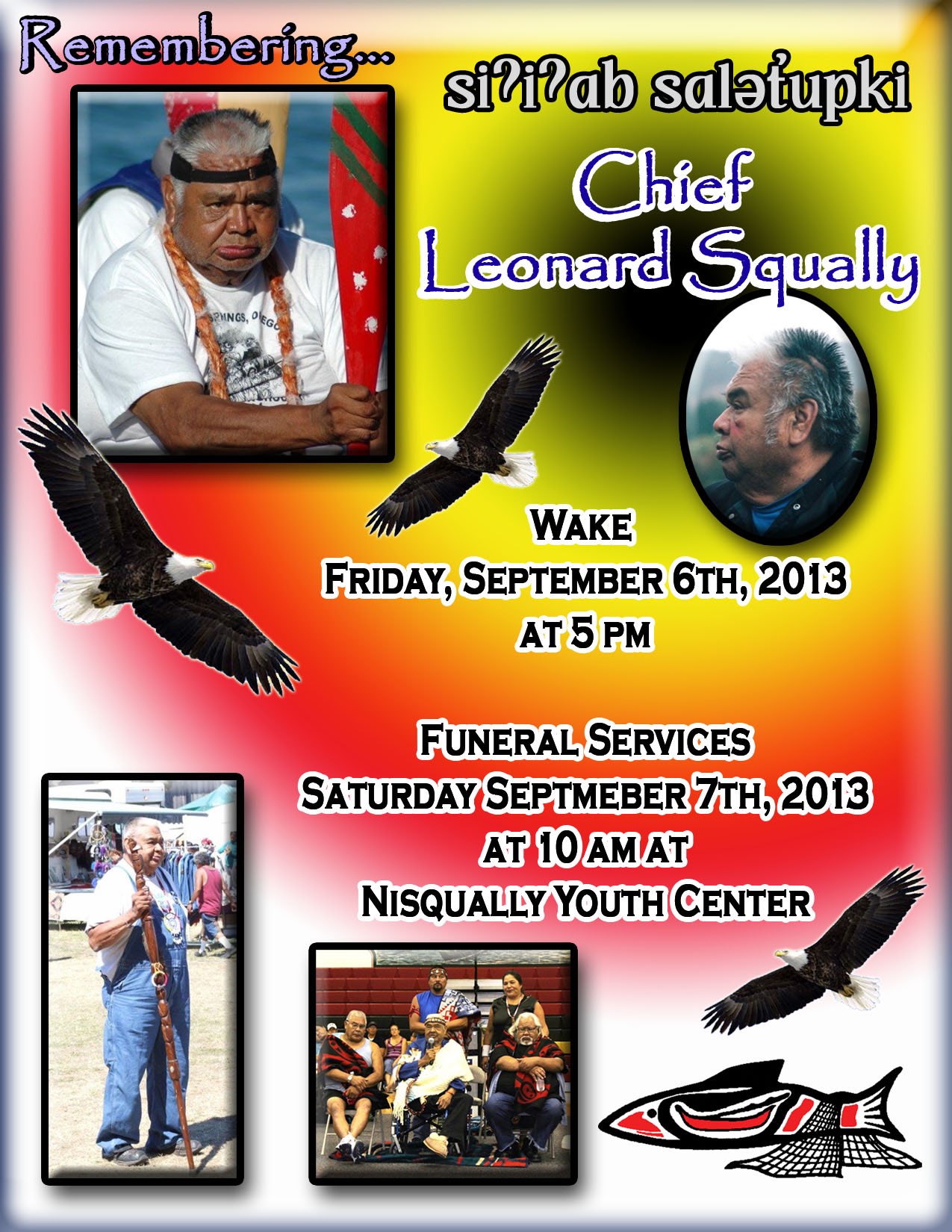
Cheif Leonard Squally’s Wake on Friday, September 6th, 2013, 5pm. Nisqually Youth Center.
Salatupki Chief Leonard Squally April 4, 1934 – August 3, 2013 Chief Leonard Squally passed away August 3, 2013 at home. He was preceded in death by his parents, brother Kenny, sister Karen, sons Leander and Kelvin, and wife Colleen. He is survived by son Robert, brothers Lewis and Albert, sisters Caroline Byrd and Elizabeth Thomas, and numerous nieces, nephews, grandchildren and great grandchildren. A wake will be at 5pm on Friday, September 6, 2013. Funeral will be at 10am on Saturday, September 7, 2013 at the Nisqually Youth Center. The family would like to thank Providence St. Peter Hospital and Hospice, The Nisqually Clinic, and the Nisqually Tribe for the care and attention given to Chief Leonard. We would also like to thank family and friends for their support at the end.
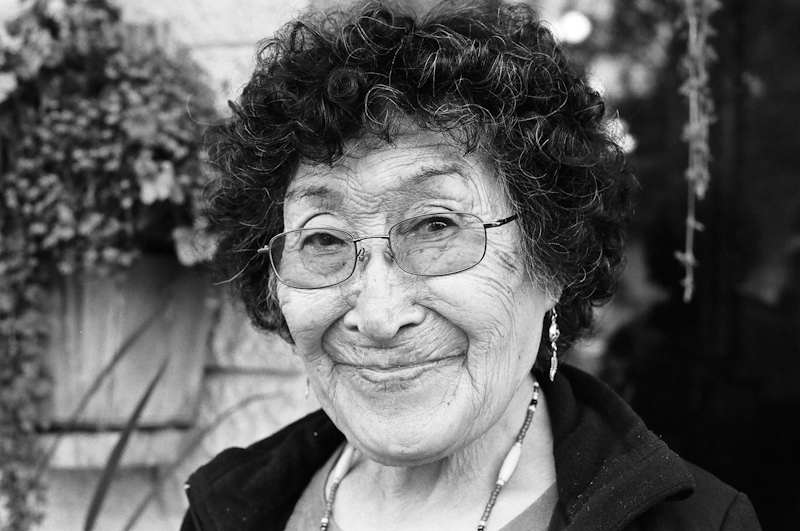
Grandmother Rita Pitka Blumenstein is a Yupik Elder and the first certified traditional doctor in Alaska. She is also an artist, a teacher, speaker and storyteller. Rita’s teachings of the “Talking Circle” have been recorded and published, and she’s traveled the world to teach song, dance, basket weaving and cultural issues. She donates these earnings to Native American colleges.
Grandmother Rita was born on a fishing boat. Because her father died before she was born, Rita was raised by mother, grandmothers and great-grandmothers. All were wise women elders of her Yupik people. “I grew up with the Grandmothers, walked with the grandmothers and learned with the grandmothers,” she said of her family’s powerful teachings.
Grandmother Rita’s family lived in Tununak on Alaska’s Nelson Island. The bitter cold and barren tundra made life hard for the Yupik, whose name means “Real People.” With no forests or trees, the Yupiks said special prayers for the return of the driftwood each year. They also prayed to the animal spirits for help.
Rita began learning while in her mother’s womb. “My mother taught me that her tummy was my first world, and whatever she did while I was in her was something I learned,” Grandmother Rita says. ” Being in the Mother’s womb is like being under the ice; unsure of the light and hearing things but not clearly.” From the time of her birth, the Yupik grandmothers recognized Grandmother Rita’s spiritual being and healing powers.
When she was a young child, Grandmother Rita had diphtheria for two years and could barely breathe. All she could do was listen. By age 9, she was already receiving visions and was working as a healer. In a recent vision, she saw people looking up at the sky in terror. It turned out to be 9-11.
Rita’s grandmothers stressed that school is important, but more important was learning about oneself. From a young age, Yupik youth are taught that when they think of something, they also need to feel it. And when they feel something, they also need to think about it. “It is essential to allow yourself to know what you know, instead of driving yourself to be,” she believes. “When there is so much striving to be and become, we don’t often recognize what it is we really want when it’s right there in front of us.”
School helped balance Grandmother Rita between two worlds. Yupik people struggled with U.S. policies that ended the tribe’sfishing and hunting rightsand forced their children to attend schools outlawing tribal languages and traditions. “I caught the tail end of the old ways,” said Grandmother Rita. She believes her name, ” Tail End Clearing of the Pathway to the Light” reflects her mission to heal. “Theceremonies,the Potlach are old ways. I can see now, today, that all that happened back then was for this purpose, for this life we are living today. It was for my work now. The ceremonies were about what all our ancestors were doing for the future, for future use. We just didn’t know back then that meant today.”
Grandmother Rita was married happily and peacefully to a Jewish man for over 40 years. During those years, they had six children but five died. Today their living daughter jokingly calls herself a “Jeweskimo.”
In 1995, Grandmother Rita learned she had cancer. The cancer helped Rita recognize her lifetime of anger and sadness from not having a father. She knew she had to heal at the deepest levels. “Emotions become physical, and the physical becomes emotional. Healing is about peeling,” she says. “God said there is only abundance, and the only way through is to forgive. Holding on to negative emotions becomes caner or another illness. Our healing is not just for ourselves, it is for the universe. We forget who we are, and that is the cause of our illness.”
Today Grandmother Rita Blumenstein is a tribal doctor for the South Central Foundation. She uses plant and energy medicine to heal along with the wisdoms learned from her own grandmothers. “I really still don’t know what it is I do, and I don’t know after what I did,” she explains. “The secret is that I don’t know anything. I am your friend, I am not sick, not sad, not angry. But what about you?”
Grandmother Rita is also teaching her teen-age granddaughter — who “talks to Mother Earth” — to be a healerand carry on the traditions. She tells her granddaughter that the whole universe is for everyone’s use. Nothing is to be owned, only shared. “We are all here for the universe … Everything changes except the land we live on, and when that changes, we must accept it …When Mother Nature shows us she’s angry, that changes all of us. My Grandmother taught me long ago that you become a human being when you learn to accept., when you learn to let go. We are here for the universe.”
Inviting the grandmothers to come visit her in Alaska , Grandmother Rita said,” When people think of Alaska, they go, ‘Brrr.’ But I say, when you have a cold heart, that’s when you’re cold. When you have a warm heart, that’s when you are warm. Come to Alaska, and we’ll warm you up!”
Phil Lane Jr. is an enrolled member of the Yankton Dakota and Chickasaw First. National Indian Magazine named Phil named a Modern Indian Sports Great for his record-breaking accomplishments in track and wrestling in 1977. For 44 years, he has worked with Indigenous peoples in North, Central and South America, Micronesia, South East Asia, India, Hawaii, and Africa. For 16 years he taught at the University of Lethbridge, in Alberta, Canada. With elders from across North America, Phil co-founded the Four Worlds International Institute (FWII) in 1982.
Today he chairs the Four Directions International, an indigenous-owned economic development company incorporated in 1996, focusing on the importance of culture and spirituality in development. Phil is an award-winning author and film producer, whose credits include “Images of Indians, “Walking With Grandfather,” and “Healing the Hurts.” He has been honored by Indigenous elders as Hereditary Chief through a traditional headdress ceremony. He was the first indigenous person to receive the Windstar Award, and has been honored by the Foundation for Freedom and Human Rights, in Switzerland, and the Center for Healing Racism in Houston.
Welcome! It is an honor to contribute and give another voice to the “The First Peoples” of our world.
Make No Bones About It. * KAOS 89.3 FM
Sundays 4pm to 6 pm with your Host, Raven Redbone.Visit KAOS 89.3 FM @ www.kaosradio.org!
Make No Bones About It
Make No Bones About It- Sound Cloud
World Peace and Prayer Day 2013
Encouraging Words from our Elders
"I appreciate your work in giving voice to our peoples. Blessings to you." Grandmother Mona Polacca
Quote of the Month
Yes, our life energy must be a gift for our future. Your life, my life, everybody’s life must follow your given path. So pray or meditate. Follow your inner path and learn just how powerful you are and learn that you are a leader for your people, your family, your children, and the Mother Earth.
-Chief Arvol Looking Horse, Lakota


 Grandmother Rita’s family lived in


 Make No Bones About It