Tag Archives: KAOS 89.3 FM

Orville H. Huntington on Perspectives from the Arctic Sunday, April 3 · 5:00pm – 6:00pm

Orville H. Huntington on Perspectives from the Arctic-Climate Change and Tribal Perspectives

Dr. Orville Huntington
Orville Huntington is a wildlife biologist, hunter, and community leader, living in the remote Athabascan community of Huslia. While preferring to stay home with “my girls” (his two daughters) he has served on the Alaskan Native Science Commission.

Orville Huntington is presently the Chair of the Interior Athabascan Tribal College. He also currently is serving as the Interior Villages Representative on the Alaska Federation of Natives Board for the 43 villages in the Doyon area, and makes his home in the Athabascan community of Huslia, a village in the Yukon-Koyukuk region of Alaska.

Orville works exclusively with professors, non-profit organizations, and colleges regarding the issue of “Climate Change Impacts and the Sustainability of Rural Communities.” He also uses and continues to develop the Native American Traditional Ecological Knowledge database.

His research interests are the direct and indirect impacts of subsistence use on fish, animals, and plants of northern ecosystems; the evaluation of currently policy and regulations and their affects on the subsistence methods and means of harvesting fish, wildlife, and plants. Orville is also committed to education and outreach projects that help non-Alaskans understand the culture and subsistence lifestyle of his people.

Orville has extensive experience in presenting to the public. He has given keynotes at various ARCUS Arctic Forums and has spoken on panels at the Smithsonian National Museum of Natural History. In 2000, he participated in the Arctic Visiting Speakers’ program as a presenter at the Marine Science Institute at Port Aransas, Texas. He enjoys the Arctic Visiting Speakers’ program because it allows him to, “share and add to what little knowledge is out there on matching Native American Traditional Knowledge with contemporary western science.”

He is interested in presenting to school audiences (K-12), academic audiences, graduate seminars, and the general public. Orville is not available during mid-June through mid-July or September due to subsistence activities

Raven visits with his guest Linley B. Logan 3-13-2011 at 5pm

My home is the Tonawanda Seneca Nation. I interact as a multidisciplinary artist ranging from the traditional arts to contemporary artistic expression. My artistic educational background includes industrial and graphic design, and multidisciplinary fine arts. The wealth of my employment experience encompasses cultural artistic consulting, and presentation. I have curated and cocurated two contemporary Haudenosaunee (Six Nations …Iroquois Confederacy) art exhibits. I have authored articles published by the Smithsonian Institution. I have presented cultural program presentations for the Smithsonian Institution. I have served on numerous grant review panels. I participated by invitation in two International Indigenous Visual Artists’ Gatherings in Hawaii 2007, and Rotorua, New Zealand 2010. I serve on local, and regional arts boards.

I interact as a multidisciplinary artist with my foundation in the traditional arts and my applied artistic statement conveyed through contemporary artistic expression. I have engaged a broad range of the two-dimensional arts from printmaking to painting, and in the three dimensional arts worked in carving, silver jewelry, pottery and three-dimensional lost and found art creations.

I attended the Institute of American Indian Arts, Santa Fe, New Mexico. I received an AFA in Two Dimensional Arts, and AFA in Three Dimensional Arts, and engaged Museum studies, 1985.

I attended a session in ceramics at the Haystack Mountain School of Crafts, Deer Isle Main, 1985.

I attended the Rochester Institute of Technology for a BFA in Industrial Design, 1987. I have co-curated contemporary Haudenosaunee art exhibits, reviewed arts grants, and authored cultural articles on traditional dance and indigenous internet implications.

I have co-curated contemporary Haudenosaunee art exhibits. I co-curated “Iroquois Art in the Age of Casino’s”, Iroquois Indian Museum, 1995. I served on the curatorial committee representing Seneca artists for the “Where We Stand” Contemporary Haudenosaunee art, Fenimore House Museum, 1997.

I authored “Native American Dance, Ceremonies and Social Dance Traditions” published by the National Museum of the American Indian, Smithsonian Institution, 1994. A similar article titled “Dancing the Cycles of Life” is published in the 1993 Festival of American Folklife program catalog. The article was part of the social dance in the America’s program for the Festival of American Folklife. for the Center for Folklife programs and Cultural Studies, Smithsonian Institution, 1993.

I organized and presented a number of Haudenosaunee social dance programs for the Folklife Festival, and the National Museum of the American Indian, Smithsonian Institution

Linley B. L o g a n – Seneca, Deer clan As an artists I attended the International Gathering of Indigenous Visual Arts in Hawaii, 2007. I accepted the invitation to participate in “Creation, Migration, and Change” an indigenous arts forum, co-organized by the Seventh Generation Fund and
sponsored by the Ford Foundation. I accepted the invitation to participate in the Te Tihi International Gathering of Indigenous Visual Arts hosted by the Maori people in Roturura (New Zealand) in 2010.

In the mid 90’s I authored the grants, developed and directed a Cultural Retention Program in the Tonawanda Seneca Nation. The Cultural Retention Program focused on researching documentation of our social and ceremonial song & dance traditions. As founder and director of the Cultural Retention Program, I published the Cultural Retention Program Newsletter (vol. 1, issue 1) for the Tonawanda Seneca Nation. My employment experience includes the Center for Folklife and Cultural Heritage Office and the National Museum of the American Indian, Smithsonian Institution. I have served on numerous grant review panels from the NEA Folk and Traditional Arts grant review panel, All Roads Seed Film program for the National Geographic Society,
“ARTOGRAPHY” the Ford Foundation/Leveraging Investments in Creativity, Michigan Council for the Arts, and the Longhouse Education and Cultural Center @ the Evergreen State College. I have reviewed Community Spirit Award nominations for the First Peoples Fund for seven years, as well as their Cultural Capitol grants. I have served on National Initiative to Preserve American Dance forums.

I have authored articles on Haudenosaunee social dances, “Dancing the Cycles of Life” Native American Dance, Ceremonies and Social Dance Traditions, published by the National Museum of the American Indian, Smithsonian Institution.

I have authored articles, co-curated contemporary Native Art exhibits, founded and directed a Cultural Retention Program in Tonawanda.

I live in Bremerton, Washington and serve on local, county, and regional arts boards. I currently serve as the Chairman of the Kitsap County Arts Board.

I served in many capacities for the Tonawanda Seneca’s Traditional Chiefs Council from education to health issues. I also served the Six Nations Confederacy’s Traditional governement concerns such as repatriation and environmental issues. There are many aspects of Cultural identity that shape my art that I engage. I servedon the Haudenosaune Repatriation Committee for the Tonawanda Band of Senecas.This experience defines relevance of repatriation issues reflective of our sacred ceremonial, and medicine society values. I fulfill a role within our religious way of life which obligates my participation to ensuring our ceremonial way of life.

I aso served on the Haudeosaune Environmental Task Force representing the Tonawanda Seneca Chief’s Council. The HETF developed a Environmental Strategic Plan which addressed our Environmental concerns for presentation to the United Nations Environemental Protection Agency. Our environmental values assert our Linley B. L o g a n – Seneca, Deer clan relationship and stewartship of balance within the natural world. My ability to articulatea cultural perspective of values has lead to my being invited as an Elder for the Traditional Ecological Knowledge Sumit, hosted by the National Oceanic and Atmospheric Association, in Hawaii. The repatriation and Environmental experiences enhance articulation of a cultural identity which benefits artistic perspective and articulation for me as a Seneca. I currently live in Bremerton, Washington and serve on local, county, and regional arts Boards Linley B. L o g a n – Seneca, Deer clan

Raven speaks with Lonny Peddycord about Intergenerational Trauma

Sunday, February 20 · 5:00pm – 6:00pm -Raven speaks with Lonny Peddycord about Intergenerational Trauma

This conference is coming to the Pacific Northwest. Join us as we get an update with Lonny Peddchord. Info is below:

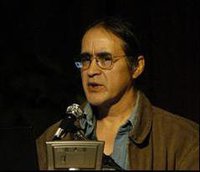
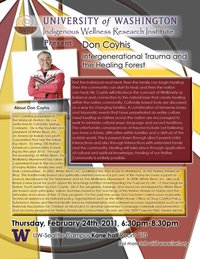
Intergenerational Trauma and the Healing Forest

First the individual must heal, then the family can begin healing; then the community can start to heal; and then the nation can heal.

Mr. Coyhis will introduce the concept of Wellbriety as balance and connection to the natural laws that create healing within the native community. Culturally based tools are discussed as a way for changing families. A combination of immense losses a…nd traumatic events that have perpetrated an entire culture need healing as natives across the nation are encouraged to seek to reinstate cultural ways, language and sacred traditions. The unfortunate consequences of trauma include not believing you have a future, difficulties within families and a distrust of the outside world. This is passed down through direct parent-child interactions and also through interactions with extended family and the community. Healing will take place through application of cultural and spiritual knowledge. Healing of our Native Community is entirely possible.

Even if you cannot attend, please share this event to others who may wish to attend.

see the following webpage for a map of where to find Kane Hall,

http://www.washington.edu/home/maps/northcentral.html?KNE

If you park in the garage across the street from the school of social work on 4101 Fifteenth Avenue Northeast, Seattle, WA 98105-6299.
travelling South on 15th ave, turn left into underground parking garage and ask the parking attendant what level to park for direct access into Kane Hall.

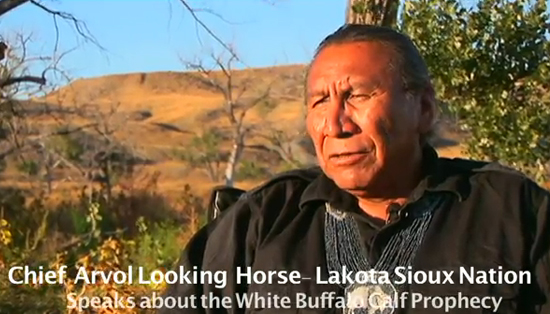
Chief Arvol Looking Horse comes to Olympia Washington 2-13-2011

Chief Arvol Looking Horse comes to Olympia Washington for a Visit. February 13, 2011 from 7pm to 9pm – Evergreen State College -Longhouse Education and Cultural Center

Chief Arvol Looking Horse

The Opportunities, the Challenges, and Promises of 2011 and Beyond.

Chief Phil Lane Jr. is an enrolled member of the Yankton Dakota and Chickasaw First Nations and is an internationally recognized leader in human and community development. He was born at the Haskell Indian Residential School in Lawrence, Kansas in 1944, where his mother and father met and attended school. He is a citizen of both Canada and the USA.

During the past 43 years, he has worked with Indigenous peoples in North, Central… and South America, Micronesia, South East Asia, India, Hawaii and Africa. He served 16 years as Associate Professor and Founder and Coordinator of the Four Worlds International Institute at the University of Lethbridge, Alberta, Canada. Four Worlds became an independent Institute in 1995. As well, Phil is Chairman of Four Directions International, an Aboriginal company, which was incorporated in 1996 as Four Worlds’ Economic Development Arm.

With Phil’s guidance and applied experience, Four Worlds has become an internationally recognized leader in human, community and organizational development because of the Institute’s unique focus on the importance of culture and spirituality in all elements of development. Four Directions International, the Institute’s economic development arm, is lead by its President Deloria Many Grey Horses, and is dedicated to the development of sustainable economic enterprises that support wholistic, political, social, cultural, environmental, spiritual and educational development.

In 1977, Phil was named a Modern Indian Sports Great by the National Indian Magazine, Wassaja, for his record-breaking accomplishments in Track and Wrestling. He has extensive experience in his own cultural traditions, is an award winning author and film producer and holds Master’s Degrees in Education and Public Administration. His film credits include the National Public Television series “Images of Indians” with the late Will Sampson, “Walking With Grandfather”, “The Honor of All: The Story of Alkali Lake” and “Healing the Hurts”.

In August, 1992, Phil was the first Indigenous person to win the prestigious Windstar Award, presented annually by the late John Denver and the Windstar Foundation to a global citizen whose personal and professional life exemplifies commitment to a global perspective, operates with awareness of the spiritual dimension of human existence and demonstrates concrete actions of the benefit for humans and all living systems of the Earth. At this International event, in recognition of his lineage and long time service to Indigenous peoples and the human family, Indigenous Elders from across North America recognized Phil as a Hereditary Chief through a Sacred Headdress Ceremony. Other Windstar winners include: Oceanologist Jacques-Yves Cousteau, David Brower, Founder of the Earth Island Institute, Yevgeni Velikhov, Vice President of the Soviet Academy of Sciences, Wangari Maathai, Nobel Peace Prize Winner and founder of Kenya’s Greenbelt Movement; Akio Matsumura, Executive Director of The Global Forum, and Lester Brown, President of the World Watch Institute.

On November 11, 2000, Phil received the Year 2000 award from the Foundation for Freedom and Human Rights in Berne, Switzerland. Phil is the first North or South American person to receive the award, and he joins a select international group: the Dalai Lama of Tibet, Dr. Boutro Boutros Ghali, former Secretary General of the United Nations, and British Lord Yehudi Menuhin, musician and philosopher, have, also, received the award. The foundation says the award is in recognition of Phil’s “unique contributions to improve the lives and future hopes of native populations. It is primarily based on his most special merits of promoting freedom and justice for indigenous people by building human and spiritual capacity rather than opposing oppression directly and also on his international visionary initiatives among Native populations by healing the root causes of hopelessness and despair.”

On June 21, 2008, Phil was awarded the 14th Annual Ally Award by the Center for Healing Racism in Houston, Texas. Phil received the Ally Award for his national and international work in promoting freedom and justice for Indigenous Peoples by building human and spiritual capacity that focuses on healing the root causes of racism and oppression rather than focusing on conflict. The Ally Award is an annual award presented by the Houston-based Center for the Healing of Racism to honor the achievements of those who have worked hard to achieve harmony of all ethnic and cultural groups. Special emphasis on this award is for Lane’s dedicated work as one of the primary leaders in the resolution of Canada’s Residential School issue, which involved the sexual, physical, cultural, psychological, and emotional abuse of thousands of Aboriginal Peoples in Canada.

In 2008, Phil completed his three-year tenure as Chief Executive Officer of the United Indians of All Tribes Foundation (UIATF) in Seattle, Washington. The Foundation’s achievements include the launching of the first-ever Native American Film Festival, the development of a host of innovative education programs ranging from elementary and high school curriculum design and development, to adult education, early childhood education, and the recent launching of a $3.5 million holistic poverty-alleviation program model for urban Indigenous Peoples in Seattle.

Phil has now stepped into global leadership as Chairman of the Four Worlds International Institute (FWII) and Four Directions International. The Institute’s central program initiative is the promotion of The Fourth Way. The primary focus of The Fourth Way is to unify the human family by taking a culturally based, principal-centered path that transcends assimilation, resignation, and conflict. FWII has been working to develop a comprehensive, community-based development strategy that offers educational opportunity, IC3 Global Digital Literacy Certification, Digital Social Networking Capacity, and Participatory Media Training through a global networking initiative called “Indig.e.Net.” This digitally-based, globally unifying Indigenous communications and educational initiative, to be established at the Ciudad del Saber in Panama City, Panama in 2010, will serve as one of the key components for implementing The Fourth Way.

DATE: Sunday January 30th, 2011
Time: 5:00pm – 6:00pm

Location: KAOS 89.3 FM

KAOS is a non-commercial, community radio station broadcasting at 89.3 FM in the South Sound area of Washington state. The station is located on The Evergreen State College campus, in Olympia

City/Town: Olympia, WA

Listen Live: http://kaos.evergreen.edu/listen.html

AN EVENING WITH CHIEF ARVOL LOOKING HORSE

                     AN EVENING WITH CHIEF ARVOL LOOKING HORSE

Photo by Brian Hardin

Free and Open to the Public

Opening Blessing – Skokomish Tribe Youth Drum Group

Opening Introduction – Delbert Miller, Skokomish Spiritual Leader

7pm -9 pm Sunday, February 13th, 2011
Longhouse Education and Cultural Center

Chief Arvol Looking Horse is the 19th generation keeper of the White Buffalo Calf Pipe Bundle and holds the responsibility of spiritual leader among the Lakota, Dakota and Nakota People. (Proceeds of the event will be used to help support World Peace and Prayer Day 2011 this year in Minnesota- http://www.wolakota.org/wppd.html

Sponsored by the Native Student Alliance, and the Northwest Indian Applied Research Institute.

For more information: Raven Redbone at ravenredbone@gmail.com

Flyer

Indigenous Peoples Cultural Leader Philip H. Red Eagle on KAOS 89.3

Philip H. Red Eagle is of Salish and Dakota ancestry and was born and raised in the Pacific Northwest. He is a published writer, canoe carver, publisher, editor, arts critic, educator, storyteller, museum curator, art gallery curator and cultural activist.

Mr. Red Eagle is one of the founders of the “Canoe Movement,” which has grown from a few canoes and fifty people in the early 1990s to over 100 canoes and over 6,000 people, a…nnually. The success of this movement, which has come to be called Tribal Journeys, is evident not just in its rapid growth, but also in its effectiveness as a method of cultural renewal among the native peoples of the Pacific Northwest. Mr. Red Eagle has performed the canoe journey’s Copper Ring Ceremony since 1995 and makes each ring by hand. The current count is 4,500 rings given in this contract ceremony, which calls for no alcohol, no drugs, no violence and no sex during the journey. The ceremony has proven to be one of the successful elements of teaching the Canoe Way of Knowledge. The ceremony inspires both the young and old to make changes in their lives and to commit to year-round sobriety and nonviolence.

The second edition of Mr. Red Eagle’s novel, Red Earth: A Vietnam Warrior’s Journey, was published in 2007. Red Earth is written in an American style of writing called Mythical Realism. The book contains two novellas dealing primarily with the Vietnam War, Post Traumatic Stress Disorder (P.T.S.D.) and the difficulties of coming home from war. Mr. Red Eagle served in the Navy from 1967 to 1976, where he attained the rank of Petty Officer First Class as a Machinists Mate (E-6). He served onboard two destroyers on two separate West-Pac deployments to Vietnam. His service included eighteen months In-Country Vietnam up the Nha Be River as a riverboat mechanic (1970-71).

Mr. Red Eagle has two bachelor degrees from the University of Washington, Seattle: a BFA in Metal Design from the School of Art (1983) and a BA in Editorial Journalism from the School of Journalism (1987).

Mr. Red Eagle’s presentation is sponsored by the Department of American Indian Studies and the Office of Academic Affairs. It is free and open to the public. Mr. Red Eagle’s book will be available for purchase and signing at the event. For more information, contact Dr. Jane Haladay at haladayj@uncp.edu.

Please join us for a screening of “Canoe Way: the Sacred Journey” with a discussion afterward with Philip Red Eagle (Dakota/Salish), founding member of the Northwest Canoe Movement. Monday, March 22, 6:30 p.m. in the Native American Resource Center.

A description of the film from its website (http://canoeway.org/) explains that: “‘Canoe Way: The Sacred Journey’ documents the annual Tribal Journeys of Pacific Northwest Coast Salish people. Indigenous tribes and First Nations from Oregon, Washington, Canada, and Alaska follow their ancestral pathways through the waters of Puget Sound, Inside Passage and the Northwest Coast. Families and youth reconnect with the past and each other. Ancient songs, dances, regalia, ceremonies, and language were almost lost and are coming back. Witness first hand, through the words and images of a proud people, as they share the story of the resurgence of the cedar canoe societies – and how it has opened a spiritual path of healing through tradition.”

photo by :readme.readmedia.com
http://readme.readmedia.com/Indigenous-Peoples-Cultural-Leader-Philip-H-Red-Eagle-to-Speak-on-March-31/1199457

TIME FOR CHANGE -A Voice for Mother Earth- with Tiokasin Ghosthorse

Tiokasin Ghosthorse: Tiokasin Tasunke Wanagi Oyate Tokaheya Wicakiye:
(“Ghosthorse” “Spirit Coming In” “He Places the People First”)

First Voices Indigenous Radio

Tiokasin Ghosthorse is from the Cheyenne River Lakota (Sioux) Nation of South Dakota. He holds a Masters Degree in Native American studies and Communications. He is a storyteller, poet, university lecturer, scholar, essayist, cultural interpreter, and a peace and human rights activist. Tiokasin has been described as “a spiritual agitator, natural rights organizer, Indigenous thinking process educator and a community activator.” One reviewer called him “a cultural resonator in the key of life.”

Politics for the Lakota is spiritual and is not separate from the rest of life. The issues are profound: What does it mean to be human, to be a human being? What does it mean to be civilized? Indigenous peoples are after an inclusive politics, an inclusive world. There is no word for “exclusion” in Lakota and there is no word for “me” or “I”. The responsibility of living within this worldview are far-reaching, from the beginnings of Life itself. This way of knowing and of being must be learned by all who walk with Mother Earth.

Tiokasin has had a long history in Indigenous rights activism and advocacy. He spoke, as a teenager, at the United Nations Conference on Human Rights International Covenant on Economic, Social, and Cultural Rights in Geneva, Switzerland. He has supported or participated in many of the major occupations including Wounded Knee, South Dakota, in 1973, as well as Lyle Point, Washington, Western Shoshone, Nevada, and Big Mountain, Arizona. Ever since his UN work, he has been actively educating people who live on Turtle Island (North America) and overseas about the importance of living with each other and with the earth.

He is a survivor of the “Reign of Terror” from 1972 to 1976 on the Pine Ridge Lakota Reservation, and the U.S. Bureau of Indian Affairs Boarding and Church Missionary School systems designed to “kill the Indian and save the man.”

Tiokasin is the host of First Voices Indigenous Radio for the last 18 years, 8 in New York and 10 in Seattle/Olympia, WA.

Tiokasin Ghosthorse is also a master musician, having played and a teacher of magical, ancient and modern sounds. He is one of the great exponents of the ancient red cedar Lakota flute, and plays traditional and contemporary music, using both Indigenous and European instruments. He has been a major figure in preserving and reviving the cedar wood flute tradition and has combined “spoken word” and music in performances since childhood. Tiokasin performs worldwide and has been featured at the Cathedral of Saint John the Divine, Lincoln Center, Madison Square Garden and the Metropolitan Museum of Art and at the United Nations as well as at numerous universities and concert venues. He is a maker of flute and drums.

Indigenous Knowledge and Values , “Returning to the past to move forward”

Join Raven and his guest Micah McCarty as they speak on Indigenous Knowledge and Values , “Returning to the past to move forward” with Micah McCarty.

Micah McCarty is a member of the Makah Nation, currently residing in Neah Bay, Washington. McCarty was raised in a Makah speaking household where he learned to the “old way” of singing and making costumes for performances. McCarty is also a drum maker and a woodcarver of traditional tribal imagery. Within the last several years, McCarty has been involved with reviving the ancient songs of the Makah people, as well as the imagery of his family. His work has been part of the Royal British Columbia Museum’s “Out of the Mist Treasures of the Nuu-cha-nulth Chiefs”.

http://salishreflections.wordpress.com/2010/08/25/life-on-the-edge-micah-mccarty-and-the-people-of-the-cape/

http://www.orionmagazine.org/index.php/articles/article/5101/

Samantha Crain the haunting voice behind the music on KAOS 89.3 FM


Sunday, December 19 · 5:00pm – 6:00pm Join Raven and his guest Samantha  Crain as they explore the voice behind the music.

Samantha  Crain Bio:
Anais Nin said, “Each contact with a human being is so rare, so precious, one should preserve it.” That suggestion was the muse impelling the conception of Samantha Crain’s second LP, You (Understood). Each song on this album rests on a juncture with a person, a real person, and it recounts a particular episode of life wi…th that person. The scenes and the people are not especially unusual or stirring but the idea that the precise installment will never, in all of time, happen again was enough to interest Crain. She is taking a microscope to the simplest of human interactions and feelings, turning them over in her hands, looking at them from all angles, measuring them on all sides, and taking them apart, realizing they really are exceptional but only in the smallest ways.