Tag Archives: Native American Indian

Orville H. Huntington on Perspectives from the Arctic-Climate Change and Tribal Perspectives

Orville H. Huntington on Perspectives from the Arctic-Climate Change and Tribal Perspectives 4-3-2011

Dr. Orville Huntington
Orville Huntington is a wildlife biologist, hunter, and community leader, living in the remote Athabascan community of Huslia. While preferring to stay home with “my girls” (his two daughters) he has served on the Alaskan Native Science Commission.

…Orville Huntington is presently the Chair of the Interior Athabascan Tribal College. He also currently is serving as the Interior Villages Representative on the Alaska Federation of Natives Board for the 43 villages in the Doyon area, and makes his home in the Athabascan community of Huslia, a village in the Yukon-Koyukuk region of Alaska.

Orville works exclusively with professors, non-profit organizations, and colleges regarding the issue of “Climate Change Impacts and the Sustainability of Rural Communities.” He also uses and continues to develop the Native American Traditional Ecological Knowledge database.

His research interests are the direct and indirect impacts of subsistence use on fish, animals, and plants of northern ecosystems; the evaluation of currently policy and regulations and their affects on the subsistence methods and means of harvesting fish, wildlife, and plants. Orville is also committed to education and outreach projects that help non-Alaskans understand the culture and subsistence lifestyle of his people.

Orville has extensive experience in presenting to the public. He has given keynotes at various ARCUS Arctic Forums and has spoken on panels at the Smithsonian National Museum of Natural History. In 2000, he participated in the Arctic Visiting Speakers’ program as a presenter at the Marine Science Institute at Port Aransas, Texas. He enjoys the Arctic Visiting Speakers’ program because it allows him to, “share and add to what little knowledge is out there on matching Native American Traditional Knowledge with contemporary western science.”

He is interested in presenting to school audiences (K-12), academic audiences, graduate seminars, and the general public. Orville is not available during mid-June through mid-July or September due to subsistence activities. See More

Music of Gabriel Ayala on Make No Bones About It.

COME JOIN RAVEN AND HIS GUEST GABRIEL AYALA on Sunday Evening , 3. 26, 2011 at 5 PM on KAOS Radio 89.3 fm

A member of the Yaqui people of southern Arizona, Gabriel Ayala is at the forefront of a new generation of Native Americans making a career performing classical music. He began playing the guitar as a child. He earned a Master’s Degree in Music Performance from the University of Arizona in 1997, has taught at all educational levels from elementary through college, and serves as a competition adjudicator. Although Gabriel truly enjoys being a teacher his busy touring schedule allows him to only teach in masterclass settings.

Ayala performs regularly throughout the United States and has appeared at the John F. Kennedy Center for the Performing Arts, National Museum for the American Indian, ASU Kerr Cultural Center and Oscar Meyer Theater in Madison, Wisconsin. He has been recognized by the former State of Arizona Governor Janet Napolitano, now Director of Homeland Security, for his musical achievements. In addition, he has also been honored as the Artist of the Month for the Indigenous Internet Chamber of Commerce (IICOC). Gabriel has also been named Tucson Citizen of the Month and recognized as the leading artist in Tucson for 2009 in “9 to watch in 09”. Not only is Gabriel recognized locally and in the United States but has had the opportunity to be the featured performer at the “Festival Internacional de la Guitarra Academica” in Venezuela with Performances in Caracas, Guarenas, Guatire and on National Public Television throughout Venezuela.

Gabriel was selected as one of ten musicians featured in “Native Musicians in the Groove” highlighting stories of musicians in their struggles while persevering with a career in music. He also has been featured in several media publications such as “Native Peoples”, “Indian Country Today”, “SAY Magazine” (Canadian and United States Editions), “Spirit of the Southwest (German Publication)”, “Native America Calling”, “Canadian Broadcasting Corporation” and numerous others.

Ayala has released three self-distributed albums: “Self Titled” in 2003, “I’ll Be Home for Christmas” in 2007 and “Tango!” in 2008. He has also been a featured artist on several other CD releases. Gabriel signed with record label Canyon Records to release their first classical CD, “Portraits” on Canyon Records Explorer Series- Classical. The Explorer Series is the new sub label developed by Canyon to be able to feature Native Americans performing music outside of the traditional genre. Gabriel has been breaking stereotypes amongst Native and Non-Native people by performing classical, jazz, flamenco, and new compositions of his own. In 2009, Gabriel was nominated and performed in the Indian Summer Music Awards, Native American Music Awards, Aboriginal People Choice Awards, and the Canadian Aboriginal Music Awards. He led the Native American Music Awards (NAMMY’s) with the most nominations and received Best Instrumental CD for “Tango!”. Gabriel received many accolades in this year alone including the honor of sharing the stage with Motown living legends The Four Tops and The Temptations.

As Ayala continues to travel throughout the United States and other countries he serves as an advocate for education for all youth while instilling his values of living a traditional lifestyle while abstaining from Alcohol, Drug and Tobacco. Gabriel believes in leading our children in the right direction through his philosophy, “Honor your elders, love your children, and respect your women”. Gabriel wants to share the gift of music with as many people and show children that they can become whatever they dream. Gabriel currently resides in Tucson, Arizona.

Raven speaks with Lonny Peddycord about Intergenerational Trauma

Sunday, February 20 · 5:00pm – 6:00pm -Raven speaks with Lonny Peddycord about Intergenerational Trauma

This conference is coming to the Pacific Northwest. Join us as we get an update with Lonny Peddchord. Info is below:

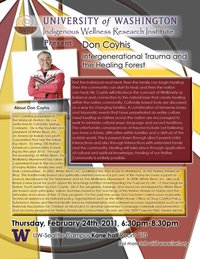
Intergenerational Trauma and the Healing Forest

First the individual must heal, then the family can begin healing; then the community can start to heal; and then the nation can heal.

Mr. Coyhis will introduce the concept of Wellbriety as balance and connection to the natural laws that create healing within the native community. Culturally based tools are discussed as a way for changing families. A combination of immense losses a…nd traumatic events that have perpetrated an entire culture need healing as natives across the nation are encouraged to seek to reinstate cultural ways, language and sacred traditions. The unfortunate consequences of trauma include not believing you have a future, difficulties within families and a distrust of the outside world. This is passed down through direct parent-child interactions and also through interactions with extended family and the community. Healing will take place through application of cultural and spiritual knowledge. Healing of our Native Community is entirely possible.

Even if you cannot attend, please share this event to others who may wish to attend.

see the following webpage for a map of where to find Kane Hall,

http://www.washington.edu/home/maps/northcentral.html?KNE

If you park in the garage across the street from the school of social work on 4101 Fifteenth Avenue Northeast, Seattle, WA 98105-6299.
travelling South on 15th ave, turn left into underground parking garage and ask the parking attendant what level to park for direct access into Kane Hall.

Don Coyhis: Healing the Trauma of the Boarding School Era

Sunday, December 12 · 5:00pm – 6:00pm Join Raven and his guest Don Coyhis as they talk about what needs to take place for the healing to happen from the Indian Boarding School Era.

President and co-founder of White Bison, Inc. Don Coyhis is a member of the Mohican Nation from the Stockbridge-Munsee Reservation in Wisconsin. His upbringing on the reservation and his 15 years of experience in corporate America bring a unique perspective on community development issue…s, whether in the corporate environment or within the Indian community.

Since 1988, Don has developed and presented community change programs based on the teachings of the Medicine Wheel and a system of principles, values and laws that were given to him by Native American Elders. He blends current events with Native American prophecy to provide a vision of the possibilities for American organizations and communities.

Don Coyhis presents Personal Enrichment, Medicine Wheel I and Community Enhancement, Medicine Wheel II in a way that will touch your heart. These audio cassette teachings on the individual, the family, the community and the nation are of vital need in today’s society.

The Meditations with Native American Elders are designed to help us grow in harmony. Each meditation begins with a saying by an Elder, followed by a thought for the day and a prayer, concluding with your intent for the day.

http://www.whitebison.org/wellbriety_movement/train_don.html

Week long Events -Time for Change: Time for Truth -Revisioning Thanksgiving 2010


People not Mascots

Time for Change: Time for Truth -Revisioning Thanksgiving

An Evening with Native American Storyteller Gayle Ross

Sunday, November 14 · 5:00pm – 6:00pm An Evening with Native American Storyteller Gayle Ross on “Make No Bones About It.”

Join Raven and his guest Gayle Ross as she shares the tradition of storytelling with us all. Through her stories comes messages for the people about treating their environment and each other with respect, and love.


About Gayle Ross
Gayle is a descendent of John Ross, principal chief of the Cherokee Nation during and after the infamous “Trail of Tears,” the forced removal of many Southeastern Indians to Indian Territory (present-day Oklahoma) in the late 1830s. Her grandmother told stories and it is from this rich heritage that Gayle’s storytelling springs. During the past twenty years, she has become one of the most respected storytellers to emerge from the current surge of interest in this timeless art form.

Gayle has appeared at most major storytelling and folk festivals in the United States and Canada, and in concert halls and theaters throughout the US and Europe, often appearing with some of today’s finest Native American musicians and dancers. She is in demand as a lecturer and visiting artist at college campuses and she continues to mesmerize children at schools and libraries across the country. The National Council for the Traditional Arts has included Gayle in two of their touring shows, “Master Storytellers” and the all-Indian show, “From the Plains to the Pueblos.” She was invited by Vice President Al Gore to perform at a gala at his residence entitled “A Taste of Tennessee” and was the only Native American speaker chosen by the White House to appear in the “Millennium on the Mall” celebration in Washington, DC. Gayle, who has published several of her stories in illustrated books, has spoken at meetings of the American Library Association, the International Reading Association, and the International Board of Books for Young People. She was a commentator in the Discovery Channel’s award-winning documentary, “How the West Was Lost,” and her stories have been featured on the National Public Radio programs “Living on the Earth” and “Mountain Stage.”

Gerald Barnes was born in Pleasant Point, Perry, Maine and now lives in Virginia. As a child he learned traditional Passamaquoddy basket weaving from his mother and father. To make his work unique, he developed the turtle as his personal symbol. For Barnes the turtle represents longevity and sustenance but, more importantly, these slightly imperfect turtles represent the adverse effects of pollution on the environment.

RESOURCES
Books by Gayle Ross
How Rabbit Tricked Otter and other Cherokee Trickster Stories.
New York: HarperCollins, 1994.
How the Turtle’s Back Was Cracked: A Traditional Cherokee Tale.
New York: Dial Books for Young Readers, 1995.
The Legend of Windigo: A Tale from Native North America.
Dial Books for Young Readers, 1996.

Anthologies including stories by Gayle Ross
Bruchac, Joseph. The Girl Who Married the Moon.
Mahwah, N.J.: Troll Communications, 1994.
The Story of the Milky Way: A Cherokee Tale.
New York: Dial Books for Young Readers, 1995.

Established in 1989 through an Act of Congress, the National Museum of the American Indian is an institution of living cultures dedicated to the life, languages, literature, history, and arts of the Native peoples of the Western Hemisphere. The museum includes the George Gustav Heye Center, a permanent exhibition and education facility in New York City, and the Cultural Resources Center, a research and collection facility in Suitland, Maryland. A new museum on the National Mall in Washington, D.C., is now under construction and will open in September 2004.

For additional information on the National Museum of the American Indian visit the museum’s Website at www.AmericanIndian.si.edu.
http://www.indiancountrytoday.com/opinion/34736534.html

http://www.youtube.com/watch?v=Kynbb7ba1tA

An Evening with Angaangaq Angakkorsuaq -October 3, 2010 at 5pm


Join Raven as he speak with guest Angaangaq Angakkorsuaq. Angaangaq Angakkorsuaq is an Eskimo-Kalaallit Elder whose family belongs to the traditional healers of the Far North from Kalaallit Nunaat, Greenland. “the man who looks like his uncle”. Uncle, as he is frequently called, bridges the boundaries of cultures and faiths in people young and old. His work has taken him to five continents and over 40 countries around the world i…ncluding South Africa, North America, South America, Asia, Arctic Europe, Russia, and Siberia. As a traditional healer, storyteller and carrier of a Qilaut (drum), he conducts Healing Circles, Intensives and sweat lodges integrating the wisdom of traditional Inuit teachings from the unwritten healing traditions of the Eskimo-Kalaallit people. Angaangaq is an internationally respected Elder for the Native Communities of the Circumpolar Arctic, North and South America and Europe. He is an highly esteemed Elder of the Canadian-based Four Worlds International Institute for Human and Community Development, the American Indian Institute Traditional Circle of Indian Elders and Youth, the World Council of Elders and the World Commission on Global Consciousness and Spirituality, acting as liaison to indigenous tribes. He is also an Elder for the Aboriginal Justice Learning Network, Justice Canada and Elder Advisor to the board of directors of the Canadian Institute for Conflict Resolution. Angaangaq is a keynote speaker at international conferences and symposia on environmental and indigenous issues. He participates in peace and spiritual vigils with the United Nations, speaking on panels for the United Nation Environmental Protection Agency, the Panel on Religion and Spirituality, the Permanent Forum on Indigenous Issues, as well as the Panel for UNESCO’s Oceans, Fishers and Hunters. His work is acclaimed in promoting interracial and intercultural harmony. Angaangaq is a member of the World Wisdom Council, an Elder of the Tribal Link Foundation, Inc. and a member of the World Commission on Global Consciousness and Spirituality acting as liaison to indigenous tribes. He is associated with the United Religions Initiative in alliance with the United Nations, the Club of Budapest International, The Masters Group, the Earth Restorations Corps., and serves on the special advisory Council to the Jane Goodall Institute. He is an Elder in association with West Virginia University and speaks frequently at Universities and colleges in North America and Europe. Sharing healing circles with leaders of small villages and indigenous tribes from around the world is among his most rewarding work. Among the world healers and speakers, Angaangaq has shared the dais with are: Jane Goodall, Dr. Phil Lane, Co-coordinator of Four Worlds International & Four Directions, Chief Oren Lyons, Faith Keeper of the Onondaga Nation, Mercedes and Geraldo Barrios, Dr. Theo Paredes, and the Zulu spiritual leader, Credo Mutwa. He is a dear friend of Grandfather William Commanda, Elder of the Algonquin Nation and the Circle of All Nations in Ottawa. Sirmiq Aattuq LLC

www.icewisdom.com

www.facebook.com/icewisdom

 www.picasaweb.google.com/icewisdom

An Evening with Ben Carnes on “Make No Bones About It.”


Ben Carnes is a Choctaw activist and writer who received the 1987 Oklahoma Human Rights Award for making a stand against forced hair-cutting policies while incarcerated. He was paroled in August 1988, and has been involved in organizing events and demonstrations on behalf of Nati…ve people and Native prisoners, including Leonard Peltier. He is currently immersed in several writing projects, including his biography that he hopes to have published before the end of 2010.

http://eaglemanz.blogspot.com

Maria Trevizo to speak on Historical Trauma among the First Peoples- June 6, 2010 5 pm

Raven and his guest Maria Trevizo speak on Historical Trauma among the First Peoples.

Maria A. Trevizo (Tigua/Mexican) is a descendent of the Ysleta del Sur Pueblo of Texas and theTarascos of Mexico.

Maria is an international speaker and has worked in the human services field over thirty-five years. She is a Certified Psychiatric Technician and Certified Substance Abuse Counselor II. She received her Bachelor of Arts degree from The Evergreen State Collage. Maria is a traditional singer and facilitator in the wellness field. She helps youth and adults to rediscover their own inner joy and beauty. As a facilitator, Maria coaches’ individuals, communities and tribes in recognizing the resilience and strength gained from working as a healthy team.

Maria works collaboratively with many North American tribes of the United States, Canada and Mexico. Maria has served as a consultant to agencies and institutions such as The Department of Health and Human Services, The Center for Disease Control, and numerous colleges and universities. Maria’s favorite work is the work she does with youth, women and the Two-Spirit Community. Maria believes that by reclaiming our traditions and ceremonies, healing is restored.

An Evening with Chenoa Egawa – May 30, 2010 5pm

Join Raven and his guest Chenoa Egawa as they talk about her music and projects.

Chenoa Egawa

Chenoa Egawa is a member of the Lummi and S’Kallam Nations of Washington State. For the past ten years, she has worked as the First Nations MESA (Math, Engineering, Science Achievement) Coordinator through the University of Washington to encourage Native students to pursue higher education and careers in science, math and engineering. Her work with MESA includes developing curriculum, workshops and classroom models that celebrate and integrate Native American culture, values, contributions, accurate history, current issues and spirituality in an effort to foster self-empowerment among Native youth and greater equity in the public educational system.

Chenoa is also a gifted teacher, singer, songwriter and performance artist and a powerful advocate for indigenous peoples. As a vocalist, she has released five CD’s— Songs of Strength and Beauty (Cool Runnings, 2007), Spirit of Salishan (Swan Clan Productions, 2007), Heartbeat of Life (Swan Clan Productions, 2006), Road of Life (Swan Clan Productions, 2002) and Sacred Fire (Sound of America Records, 1997). She was a grant recipient of the First Nations Composers Initiative in 2007 and a grant recipient of the Jack Straw Foundation Artist Support Program in 2005, and again in 2010. Her experience as an actor includes performing in lead roles in the World Premiere of Ghosts of Celilo at Portland, Oregon’s Newmark Theatre in 2007, where she also won the Portland Area Musical Theatre Award for ”Best Original Score” (co-writer); in Sacagawea, at the Oregon Children’s Theatre in 2003, and at the New Visions, New Voices series at Washington, D.C.’s Kennedy Center in May 2002. She is also host of the Native news television programs Northwest Indian News and Native Heartbeat both viewed across the Western United States, Canada, Hawaii, Alaska and New Zealand, and hosted the one-hour documentary, Inside Passage, for PBS shown nationwide. She has performed as a singer and storyteller at numerous schools, and music, arts and cultural venues.

Chenoa has long been active in international work for Indigenous peoples. In 1991, she worked as an intern at the United Nations Center for Human Rights in Geneva, Switzerland, serving as a member of the Secretariat during the 10th Session of the Working Group of Indigenous Peoples. In 1996, she was part of an international Native delegation that traveled to Chile to support Mapuche and Pehuenche Indigenous communities in their efforts to halt construction of large-scale dams on their homelands. In 1997, she received a two-year international fellowship from the Institute of Current World Affairs to study, write and publish on issues concerning Indigenous peoples of Mexico and Guatemala. She is the first, and only Native American to date, to receive an ICWA Fellowship.

In January 2010, Chenoa and her partner, Alex Turtle, were invited to Colombia, South America to participate in a cultural gathering where they shared some of their teachings with indigenous peoples of Colombia, Peru and Ecuador.

http://www.swanclan.com/index.htm