Tag Archives: First Peoples

Roger Fernandes on Make No Bones About It. Dec 16th, 2012 @5:15 PM.

251350_10101153833665120_1134789773_n

Roger Fernandes, master storyteller, Lower Elwha S’Klallam.
Roger Fernandes, or Kawasa, is a member of the Lower Elwha Band of the S’Klallam Indians from the Port Angeles, Washington area. He describes himself as an urban Indian as his mother, Violet Charles, moved to the city of Seattle where he was born in 1951. English surnames are common in the Puget Sound region and his family name is Charles. His great-grandmother was Annie Ned from Sequim, who married into the Makah tribe and moved to Neah Bay, the h
ome of the Makah people on the northern Olympia Peninsula. He is from a family of four brothers who are all active doing various cultural things like singing, basket making, artwork and storytelling.

Today the Lower S’Klallam are at the north end of the Olympic Peninsula in Washington just north of the Olympic Mountains foothills and the shores of the Straits of San Juan De Fuca. The reservation is about ten miles outside of Port Angeles, Washington.

Roger has been storytelling for about seven or eight years. The stories he started with were simple legends. Through his own interest and doors being opened by understanding those stories he moved into telling myths, creation stories, flood stories, and hero stories. In sharing these types of stories Native people can teach non-Natives about the aspects of their culture that go beyond food, shelter, and clothing. These stories actually define the culture of the tellers.

A story he shares of his tribe is how the S’Klallam people got their name. Stories incorporate songs and dances as an integral part when being told and are included in several stories that he tells. In the course of learning Native American stories, Roger has integrated stories he has learned from other cultures around the world like Mexico, Africa and Asia. All stories speak the same human language and teach same lessons.

Also a tribal historian, Roger gives a comprehensive multimedia presentation on the art of the Coast Salish people, including slides showing that the art of the Salish people. Their art is quite a bit different than that of the stereotypical northwest coastal Indian art like totem poles, masks and button blankets. He’s accumulated artifacts and artwork to show how the native people of this area created their designs, art, basketry and carving. A couple of other topics Roger uses is the environment and health and healing. He believes art, music and stories reflect the culture and the culture reflects the environment. Spiritual health that people need is told in stories that convey how a human being is to live in balance with family, community, and nature. Stories lead to a spiritual and emotional understanding on how to live in the world.

Roger is involved in art organizations and initiatives by and for Native American artists. He’s the Executive Director of South Wind Native Arts and Education Foundation a small grass roots non-profit and he’s on the arts advisory committee for the Potlatch Fund. He has recorded a CD ‘Teachings of the First People’ that shares several of the stories he tells in his performances. He won a folk life award from the Washington Arts Commission for his work in teaching about Coast Salish art. He also has a degree in Native American Studies from the Evergreen State College.

Roger does a lot of work in schools and tailors his presentations to young people. Children understand stories at one level and so he gives them access to stories that are easy to interpret. Native people call their stories “the teachings” as they are the fundamental way of teaching children. He likes them to be involved in the interpretive process. Elders have another level of understanding and bring a lot of wisdom and knowledge to any discussion so a strength that should be built on is the cross generational experience in storytelling. His audiences include community groups such as schools, libraries, parks departments, senior centers and open forum presentations that are geared towards a general audience.

Roger Fernandes
821 209 th Ave NE
Sammamish, WA 98074
425-868-7503
rbfernandes@juno.com

PHOTO BY Alex Garla
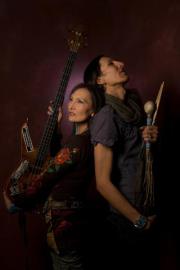
Raven visits with “Sihasin” November 18, 2012 4pm

Clayson Benally and Jeneda Benally of Blackfire are excited to announce their new musical side project “Sihasin”! A Navajo word that means Hope and Assurance is the basis for the duo’s new sound. Bass and Drums with vocal harmonies giving way to Navajo singing and melody creates a duophonic energy that leaves you with a feeling of Get Up, Stand up, use your voice and DO! Their unique new sound continues the power and energy of resistance for environmental and social injustices.
Biography
Brother and sister originally from Black Mesa on the Navajo Reservation in Arizona, were born into the heart of a political land dispute separating them by a fence from traditional homeland and family. They grew up protesting the environmental degradation and inhumane acts of cultural genocide against their traditional way of life.Their musical style encompasses many genres of music including rock, punk, folk, world. Jeneda and Clayson are at home on any stage.

Current Location
Navajo Nation, Arizona
Press Contact
bertabenally@gmail.com
Booking Agent
bertabenally@gmail.comBIO:
SIHASIN

(See-ha-szin)

Dine’ word- to think with hope and assurance. The process of making critical affirmative action of thinking, planning, learning, becoming experienced and confident to adapt.

Brother and sister, Jeneda and Clayson Benally of Blackfire from the Navajo (Dine’) Nation in Northern Arizona have created their own unique brand of music with bass and drums. They grew up protesting the environmental degradation and inhumane acts of cultural genocide against their traditional way of life. Their music reflects hope for equality, healthy and respectful communities and social and environmental justice.
http://sihasin.com/

Save Pe Sla

Will be talking to Chase Iron Eyes,  and others about what is happening in Lakota Territory. Save Pe’Sla Sunday at 4pm pacific. There is 2 lines into the station. We also have 2 hrs to let the world know what is going on and what they need to do to make it right. The number is 360-867-5267 and its 4pm pacific let me know if you are willing to call in. Thank you all for what you do for the people. Please spread the word. Pe’ Sla, also called “Old Baldy,” is vital to Oceti Sakowin star knowledge and provid…

es evidence of our historical ties to the Black Hills as well. The Black Hills are a terrestrial mirror of the heavens above. Pe’ Sla, an open, rather bare expanse of land compared to its surroundings, corresponds to the Crab Nebula, a gaseous cloud remnant of a supernova explosion that happened in 1054 AD. It is no longer visible with the naked eye- but my people remember it. Like many other Indigenous groups, our ceremonies are tied directly to the Universe and the natural cycles of Ina Maka (Mother Earth). Therefore, it only serves that Pe’ Sla, a location in the heart of the Black Hills that serves as a basis for our star maps, is also a sacred site where ceremonies must be observed each year. According to our beliefs, these rituals must be performed to keep the Universe in harmony and preserve the well being of all, Native and non-Native alike. You see, to the Lakota, Dakota and Nakota, Pe’ Sla is not merely prairie. Its grounds are holy. It is our Church of the Holy Sepulchre. It is our Mecca. Pe’ Sla is our wailing wall, where we are meant to pray. The danger of the Oceti Sakowin losing Pe’ Sla is real, and imminent. Should Pe’ Sla pass into the hands of someone other than us, it’s highly likely that it will be developed. The State of South Dakota has expressed that it wants to use eminent domain to build a road right through the heart of Pe’ Sla. Development of Pe’ Sla would effectively cut off our access to it, and spell its destruction as a sacred site. Worse yet, we only have 9 days left before auction day. After analyzing our legal options, it was understood that due to time constraints and the fact that Pe’ Sla is currently owned by a private party (the Reynolds family), our only viable option to ensure Pe’ Sla remains a sacred site for future generations of Oceti Sakowin, as well as other Tribes like the Cheyenne and Kiowa who hold similar beliefs and ceremonies, was to buy it. The cost for Pe’ Sla at auction, also called “Reynold’s Prairie,” is estimated to run anywhere from $6 to $10 million. Chase Iron Eyes, founder of Lastrealindians.com, Inc., spearheaded the effort to save Pe’ Sla. Rodney Bordeaux, President of the Rosebud Sioux Tribe, took the initiative to bring his concerns about Pe’ Sla to the Rosebud council, who voted to act as a conduit to unite all Oceti Sakowin Tribes. Within days, the collaborative effort to save Pe’ Sla spread far and wide across the Dakotas, and now, the nation. Grassroots efforts have mobilized Oceti Sakowin Tribal members who are working hard to find solutions, and raise awareness. Right now, in council chambers across The Sioux Empire of old, Tribal leaders are working, against all odds, to raise enough money to buy back land that was stolen from them by the U.S. government. Remember, the Sioux never accepted the Black Hills Settlement as proposed by the United States Supreme Court- who held that the Black Hills were wrongfully taken from us. This effort, by the united Oceti Sakowin to save one of our sacred sites, is unprecedented. Unlike stereotypical portrayals, the majority of Sioux Tribes still struggle financially. Unemployment is high, and many Tribal members live in poverty. Yet there are traditional Lakota, Dakota, and Nakota who are prepared to give till it hurts to save Pe’ Sla. Pe’ Sla is rightfully ours. It was passed down to us from our ancestors, who were here many millennia before European invaders arrived. Now we implore you; stand with us. We need your help. Pray for us and our efforts to save Pe’ Sla. Share this story. Contact your congressman and voice your concerns for Pe’ Sla, the Oceti Sakowin sacred site that’s on the auction block. Contribute to our cause to buy back Pe’ Sla. Donations may be made online with LastRealIndians here or through the Rosebud Sioux Tribe/Pe Sla, 11 Legion Ave., P.O. Box 430, Rosebud, SD 57570. All donations to the Tribe are tax-deductible and will only be used toward the purchase of Pe Sla. We’ve drawn a line in the sand. This effort may take all we’ve got, but we won’t lose Pe’ Sla without a fight. We are doing it for our children, and yours. Ruth Hopkins (Sisseton-Wahpeton/Mdewakanton/Hunkpapa) is a writer, speaker,former science professor and tribal attorney. She is a columnist for Indian Country Today Media Network and LastRealIndians.com. Read more:http://indiancountrytodaymedianetwork.com/ict_sbc/black-hills-auction-saving-pe-sla http://indiancountrytodaymedianetwork.com/ict_sbc/black-hills-auction-saving-pe-sla#ixzz24F7Wex00

Tribal Journey 2012

PBS NewsHour features Swinomish Climate Change Initiative and Billy Frank Jr.

Program: PBS NewsHour

Episode: Northwest Salmon People Face a Future Without Fish

For Northwest tribes, salmon fishing is more than a food source, it’s a way of life. Now the climate may push the fish towards extinction. Together with KCTS9 and EarthFix, NewsHour visited the Swinomish Indian reservation to see how they are coping.


http://video.pbs.org/video/2257248299

A Visit with Ray Ward of the Chumash Nation

We will be visiting about the Chumash returning with the Tomol to Salish Country. Very excited to have this visit with Brother Ray!!

Ray Ward is a captain of the ‘Elye’wun and the Chair of the Chumash Maritime Association. Ray, and other members of the Chumash community, created a beautifully tiled artwork at the village of Syuxtun (West Beach) in Santa Barbara. The Syuxtun Story Circle won the Santa Barbara Beautiful Award for Public Art in 2010. Ray is currently heading the building of the BCC’s community tomol. Our newest tomol is nearly built and is expected to do her first voyage this Spring 2012.

Click to visit the Chumash Maritime Association
http://www.chumashmaritime.org/

Chief Phil Lane Jr – International Indigenous Leadership Gathering 2012

The Fulfillment of Indigenous Prophecies, Alberta Tar Sands, Rio+20, Unceded Territory, Broken Treaties,International Legal Order, Canadian Legal Order, International Legal Order and the upcoming “Avatar Moment” For more info, visit http://www.iilg.ca/

Global Economic Challenges and Indigenous Prophecies with Chief Phil Lane Jr.

Raven visits with Chief Phil Lane this Sunday, June 17th, 2012 at 4pm.

Phil Lane Jr. is an enrolled member of the Yankton Sioux and Chickasaw Nations and is an internationally recognized leader in human and community development. He was born at the Haskell Indian Residential School in Lawrence, Kansas in 1944, where his mother and father met and attended school. He is a citizen of both Canada and the USA.

During the past 44 years, he has worked with Indigenous peoples in North, Central and South America, Micronesia, South East Asia, India, Hawaii and Africa. He served 16 years as Associate Professor and Founder and Coordinator of the Four Worlds International Institute at the University of Lethbridge, Alberta, Canada. Four Worlds became an independent Institute in 1995. As well, Phil is Chairman of Four Directions International, an Aboriginal company, which was incorporated in 1996 as Four Worlds’ Economic Development Arm.

With Phil’s guidance and applied experience, Four Worlds has become an internationally recognized leader in human, community and organizational development because of the Institute’s unique focus on the importance of culture and spirituality in all elements of development. Four Directions International, the Institute’s economic development arm, is lead by its President Deloria Many Grey Horses, and is dedicated to the development of sustainable economic enterprises that support wholistic, political, social, cultural, environmental, spiritual and educational development.

read more about Chief Phil Lane Jr.

Indigenous People Light Sacred Fire Ahead of Rio+20

Chief Arvol Looking Horse Returns for a visit to the Northwest 5-20-2012 7pm


Chief Arvol Looking Returns for a visit to the Northwest. Chief Arvol Lookinghorse the Keeper of the Sacred White Buffalo Calf Pipe. Come share a moment with Chief Arvol Looking Horse and his message to Humanity.

Chief Arvol Looking Horse will be returning to Salish Country to share his message Peace, Love and our responsibility to Unci Maka (Mother Earth). Chief Looking Horse will be speaking at Native Quest this May 20th, Sunday at 7pm. The New Earth Agreements 2012 & Beyond. Come & learn how you can walk in love, peace & harmony.

Protecting and Restoring the Sacred with Chief Phil Lane Jr 4pm 4-8-2012

Chief Phil Lane Jr. makes opening offering at First Nations solidarity event opposing tar sands mining and pipeline operations in Canada.

Members of the Canadian Protecting and Restoring the Sacred CC joined First Nations of that region in a standing-room-only event in Vancouver BC, calling for free, prior and informed consent regarding environmental protections of the fragile BC coastline, and in opposition to Alberta Tar Sands operations.

Noted author and XL Pipeline activist Naomi Klein (The Shock Doctrine) spoke, along with several Indigenous leaders, about the threat oil pipelines and supertankers pose in the waters and environment of British Columbia. Two major pipeline projects are proposed through the region that would bring tar sands oil through BC and to Canada’s west coast for export.

The diverse group attending the event included Chief Jackie Thomas of the Saik’uz First Nation (speaking on behalf of the Yinka Dene Alliance), who related her people’s fierce commitment to this struggle and opposition to the pipeline:

“Our five nations hold more than 25 percent of this proposed pipeline route in our territory, and we will never allow it to be built!”

ar Sands operations in Alberta, Canada – Before & After

The feeling in the room was one of “enthusiasm and unity”, according to the Vancouver Observer.

Over 130 signatories have now joined the “Save Fraser” declaration.

“The declaration says it upholds our ancestral laws, the title, rights and responsibilities that we hold. We will not allow the proposed Enbridge Northern Gateway pipeline, or any similar tar sands pipeline, to be built. This is our law,” said Chief Thomas.

Vauncouver Observer reports that

“(Along with) Thomas and Chief Phil Lane, a number of other Aboriginal leaders stood to address the crowd. Sundance Chief Reuben George of the Tsleil-Waututh Nation gave introductions and brought his entire family on stage to welcome guests to unceded territory. First Nations actor Adam Beach also brought his children on stage, tearing up during a song about ensuring their future. And later, 10-year-old Ta’Kaiya Blaney sang a heartfelt song urging citizens to join the “earth revolution”.”

Quoting from the Vancouver Observer:

“(Melina Laboucan-Massimo, a Greenpeace campaigner from the Lubacon Lake Cree Nation in Alberta) went on to describe a disastrous spill that occurred in May 2011, when 28,000 barrels of tar sands crude leaked all over the traditional territory. She said neither the company (Plains All American) nor the government had attempted to notify the community, despite the fact that residents and schoolchildren were getting sick from the effects. Fighting back tears, Laboucan-Massimo displayed a series of aerial photographs taken in the days following the spill.”

Commenting via email on the event, URI Global Council Trustee Rebecca Tobias went on to add:

“It was an uplifting and encouraging event. I believe that we will see more of these positive, future-focused gatherings all across the US and Canada as people begin to find their voice and renew their commitment to building communities of conscience. Members of URI’s Protecting and Restoring the Sacred CC, Chief Phil Lane Jr.and Sundance Chief Reuben George, took part in the planning and presentation of the evening’s program, keeping true to URI’s commitment to, ‘unite in responsible cooperative action to bring the wisdom and values of our religions, spiritual expressions and indigenous traditions to bear on the economic, environmental, political and social challenges facing our Earth community.'”

(Much of the above account is derived from a report in the Vancouver Observer. For the complete story, see: http://www.vancouverobserver.com/sustainability/2011/12/02/naomi-klein-and-first-nations-leaders-unite-anti-pipeline-forum?page=0%2C1 )