ALEX WHITE PLUME is Oglala Lakota and one of the founders of the Sitanka Wokiksuye (Wounded Knee Bigfoot Memorial Ride) (South Dakota) started in 1986. The nation needed a Wiping of the Tears ceremony after the massacre at Wounded Knee in 1890. The ride began because of the way our people were living; they needed change and a way that brought awareness to what happened to Bigfoot and his people at Wounded Knee. “MOTHER EARTH NEEDS CULTURE.” – Alex WP
To see some of Alex s work go to (www.oweakuinternational.org).
Between 1986-1990, the ride was a Wiping of the Tears ceremony for the Lakota nation. There were 19 riders on the very first ride in 1986 from Bridger, SD to Wounded Knee, SD. The ride was called the Future Generation Ride after 1990, when the Wiping of the Tears ceremony ended.
Posted onDecember 20, 2013|Comments Off on Learn about the MPA Tribal Governance Concentration here on KAOS 89.3 fm at the Evergreen State College with Puanani Nihoa, on Make No Bones About It. December 22, 2013 from 4:30-5pm.
Brief Summary for Puanani Nihoa:
2013 April: Currently I am the Assistant Director for the MPA Tribal Governance Concentration 2010-2013
(prior to April):Project Archivist: 2 yr. grant funded archival project finding aides were completed for the following collections; all has been web-published in the Northwest Digital Archives web-site:
*Guide to the Angela Gilliam Papers 1988-2003*
Guide to the Elizabeth Enslin Papers (small collection) 1994-1995*
Guide to the Janice Kido Papers 1989-2000*Guide to the Jovana Brown Papers 1981-1994*
Guide to the Kaye V. Ladd Papers 1975-1978*Guide to the Linda Moon-Stumpff Papers 1988-2001*Guide to the Louise Williams Papers 1966-2004*Guide to the Lovern King Papers 1990-1992*Guide to the Margaret Hunt Papers 1976-2000*
Guide to the MPA Tribal Governance Concentration 1980-2013*Guide to the Nancy Taylor Papers 1974-2004*
Guide to the Northwest Indian Applied Research Institute Records (NIARI) 1999-2012 [initial work has been completed, currently detail processing is being conducted to further expose material recently received-processing should be completed in the next month by an intern from San Jose University-Sarah Norton]*Guide to the Rebecca Goolsby Papers (small collection) 1994-1995*Guide to the Virigina Grant Darney Papers 1979-1993*
Guide to the Washington State Folklife Council Project Archive Collection 1983-1990 *Guide to the Winifred Ingram Papers 1938-19922008-2010 Attend MPA Tribal Governance Concentration-graduated with Master’s in Public Administration-Tribal Governance Concentration While attending school worked as a processing and project archivist 2007
Bachelors of Arts degree-TESC
Worked as Administrative Assistant for the VP of FAD at TESC
Concurrently volunteered as a processing archivist Prior to TESC: 5 years experience working as an Information Technology Analyst for a utilitarian software company (private) 20 years experience working as an Administrative/Executive Assistant (public & private sectors)
Personal: Native Hawaiian & non-traditional student-Member of the Hawaiian Civic Club in LaceyVolunteering as Processing Archivist Consultant currently
Comments Off on Learn about the MPA Tribal Governance Concentration here on KAOS 89.3 fm at the Evergreen State College with Puanani Nihoa, on Make No Bones About It. December 22, 2013 from 4:30-5pm.
Robert is the Director of Blue Pony Youth Program is one of many projects that Robert is involved it. Learn more about what Robert is up too, Make No Bones About It- 12-8-2013, 5:00-5:30pm.
Robert Upham, AKA- “Harlem Indian” is a mixed blood American Indian from the Gros Ventre, Assiniboine, Dakota, Salish, Pend Oreille, and Adopted Blackfeet and Lakota. He grew up on the fort Belknap Indian Reservation near the town of Harlem, Montana. In 1994 upon the advice of his Uncle Floyd Red Crow Westerman, robert walked across the United States with Dennis Banks, co-founder of the American …Indian Movement. The walk was called the Walk For Justice and the purpose was to raise awareness of Leonard Peltiers imprisonment and the various issues across Indian Country.
He is an artist in the tradition of the Winter Count. His mediums are: Acrylic, Pen, Pencil and VIDEO. For the last 9 years he has used video to educate the public on the american Indian Cause. He is presently Director of the Blue Pony Youth Program. His major Project at this time is a movie called “the Harlem Indian Project- License to be Indian”.
The Kogi from Columbia traveled and brought a message: The temple of life is now broken, we must awaken and stand for life, because the Chief of Chaos is now reigning. No longer is it just in our communities, it has spread in our water of l…ife, in our sacred air and broken our Mother Earth. People have come to a place of not caring and wanting to go out…
I think all people better pay attention, because no one is exempt, I still believe we as humans can make a change “All Nations, All Faiths, One Prayer”.
Nov. 8th Tepco will begin moving over 1000 dangerous fuel rods, many giving their lives to do it. 2001 WPPD statement ending from Chief Arvol Looking Horse, I think it fits this terrible scenario we are ALL facing about Fukashima: “You must decide. You can’t avoid it. Each of us is put here in this time and this place to personally decide the future of humankind. Did you think the Creator would create unnecessary people in a time of such terrible danger? Know that you yourself are essential to this World. Believe that! Understand both the blessing and the burden of that. You yourself are desperately needed to save the soul of this World. Did you think you were put here for something less?” Below informational utube of what we are facing and the Elders statement. COUNCIL FUKUSHIMA STATEMENT OCT 2013
SUNDAY Only on KAOS 89.3 FM. 4:30PM PACIFIC
MAKE NO BONES ABOUT IT.
Representatives of the Council
Chief Arvol Looking Horse
19th Generation Keeper of the Sacred White Buffalo Calf Pipe Spiritual Leader
The Great Sioux Nation aka Pte Oyate Buffalo People
Bobby C. Billie
Clan Leader and Spiritual Leader
Council of the Original Miccosukee
Simanolee Nation Aboriginal Peoples
We are now at the Crossroads, please share Urgent
Nov. 8th Tepco will begin moving over 1000 dangerous fuel rods, many giving their lives to do it. 2001 WPPD statement ending from Chief Arvol Looking Horse, I think it fits this terrible scenario we are ALL facing about Fukashima: “You must decide. You can’t avoid it. Each of us is put here in this time and this place to personally decide the future of humankind. Did you think the Creator would create unnecessary people in a time of such terrible danger? Know that you yourself are essential to this World. Believe that! Understand both the blessing and the burden of that. You yourself are desperately needed to save the soul of this World. Did you think you were put here for something less?”
Julian Brave NoiseCat, son of Ed Archie NoiseCat and Alexandra Roddy, is a member of the Canim Lake Band and a descendant of the Lil’Wat Nation of Mt. Currie. His paternal grandparents are Antoinette Archie and the late Ray Peters, and his maternal grandparents are Suzanne Roddy and the late Joe Roddy. He is in his third year at Columbia University where he studies history. This summer he continued learning Secwepemctsín with his kye7e (grandmother), while conducting and writing a research paper on current and historical words for the white man in Secwepemculecw. He loves his family.
Reclaiming the Sacred and Protecting Xwe’chi’eXen from Coal
The House of Tears carvers of the Lummi community has created a tradition of carving and delivering totem poles to areas struck by disaster or otherwise in need of hope and healing. Now it is Lummi Nation’s own sacred landscape, Xwe’chi’eXen, that needs hope, healing and protection. The most imminent threat to this sacred landscape and to treaty rights associated with Xwe’chi’eXen comes from a proposal to build North America’s largest coal port: the Gateway Pacific Terminal.
THE JOURNEY
The Kwel hoy’ Totem Pole journey, September 15-29, 2013, will start in the Powder River Basin and follow the coal train route through Indian Country, up to Xwe’chi’eXen. The journey will conclude in British Columbia, where the totem pole will be placed in the homeland of the Tsleil-Waututh Nation, demonstrating unity with the Canadian First Nations’ position opposing the transport of Tar Sands by pipelines across their territories. There, the totem pole will be met by Tribes and First Nations that have travelled from all direction. The Totem Pole will be placed as a means of reinforcing the message: Kwel hoy.’
The House of Tears Carvers and a team of support people and witnesses will accompany the Totem Pole on its 1,200 mile long journey. At each event, Tribal members, non-Tribal local citizens, elected officials, and the press will be invited to attend.
CONNECTING THE PEOPLES OF THE WEST
One primary goal of the journey is to connect tribal nations along the coal corridor. Tribal Nations innately understand and honor the need to protect sacred landscapes and treaty rights. Uniting the Tribal Nations is important for this particular issue and for Tribal communities that would be affected by coal transport and export.
The proposed coal rail line and port brings very different cultural communities together in a common cause. The proposal has unique ramifications not only for Tribal Nations, but also for communities all along the rail lines and shipping lanes that would be affected by coal export. Communities, commerce, livelihoods, public health, tourism, agriculture, fisheries, air and water safety, natural resources, quality of life would all be adversely impacted. In asking for blessings and strength from communities along the coal transportation corridor, the Kwel hoy’ Totem Pole brings together the Peoples of the West. People of many faiths can stand united in protecting the sacred, and people of many traditions can support honoring treaty rights and the traditional livelihoods they ensure. People from all affected communities can stand against this project.
BACKGROUND
by Jewell James (House of Tears Carvers)
Xwe’chi’eXen (Cherry Point) has deep spiritual and cultural significance to our people. It is a sacred landscape that includes ancient reef-net sites and a 3,500 year-old village site. Our Hereditary Chief of the Lummi Nation tsilixw (Bill James) describes it as the “home of the Ancient Ones.” It was the first site in Washington State to be listed on the Washington Heritage Register and is eligible for the National Register of Historic Places.
If built, the Gateway Pacific Terminal at Cherry Point (Xwe’chi’eXen) in Washington State would be the largest coal export facility in North America. The mines are connected to the proposed port site by rail lines that run from Wyoming and Montana through Idaho, eastern Washington, along the Columbia River Gorge, and then up the coast of Puget Sound. Bulk cargo carriers would ship the coal through the Salish Sea to Asia.
The project will result in significant, unavoidable, and unacceptable interference with treaty rights and irreversible and irretrievable damage to Lummi spiritual values. As a result, the Lummi Nation in 2012 adopted a formal position to oppose the proposed project. As Lummi Councilman Jay Julius, in opposing the proposed coal port, has said, Kwel hoy’: “We draw the line.” This position was also adopted in 2013 by the Affiliated Tribes of Northwest Indians.
DOCUMENTATION/WITNESSES
Witnesses will document and publish (via this blog) photos, writings, sketches, and videos of both the journey and preparation for the journey when culturally appropriate. The blog will feature entries from Lummi Nation members and by people along the journey. Journalists, photographers and a documentary film crew will be invited along for the journey. http://totempolejourney.com
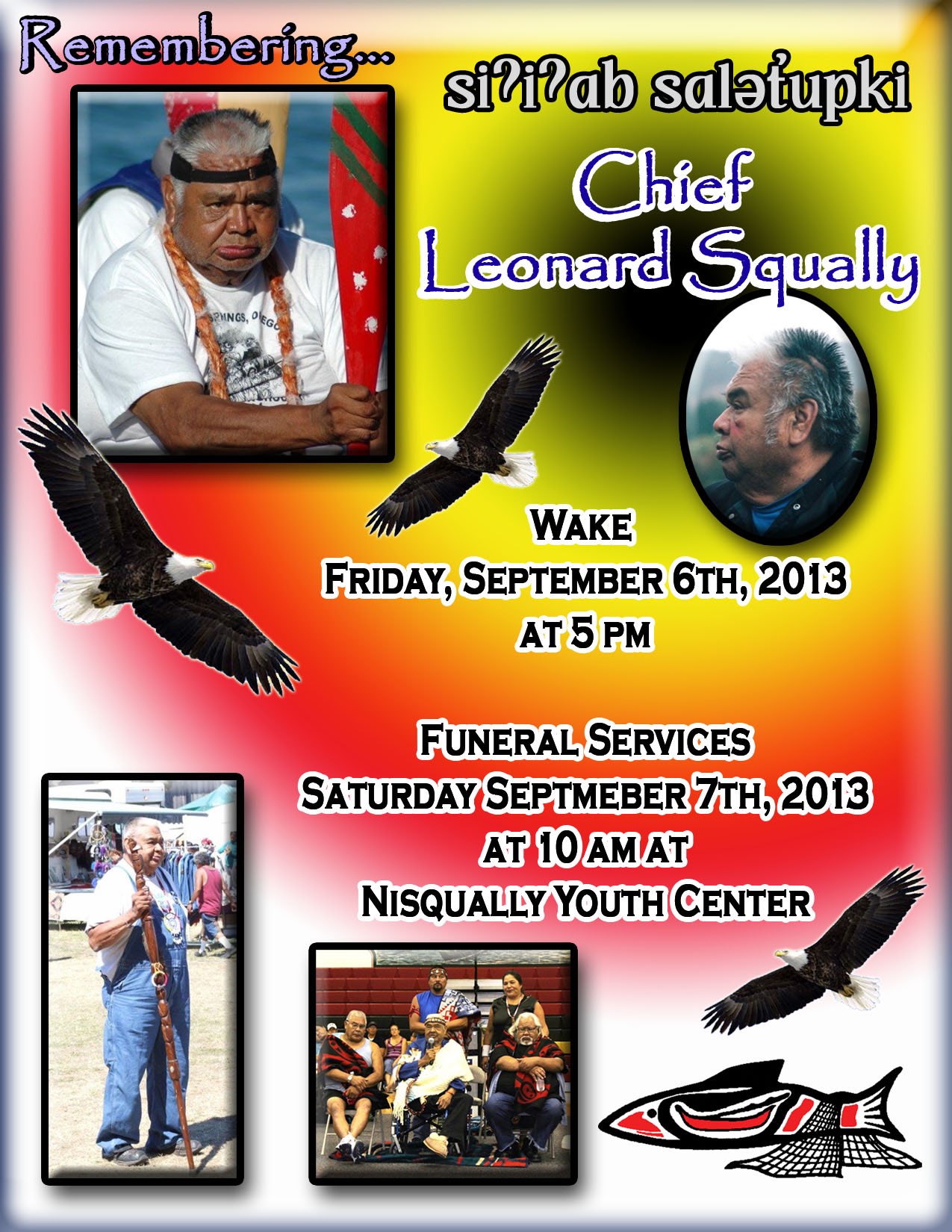
Cheif Leonard Squally’s Wake on Friday, September 6th, 2013, 5pm. Nisqually Youth Center.
Salatupki Chief Leonard Squally April 4, 1934 – August 3, 2013 Chief Leonard Squally passed away August 3, 2013 at home. He was preceded in death by his parents, brother Kenny, sister Karen, sons Leander and Kelvin, and wife Colleen. He is survived by son Robert, brothers Lewis and Albert, sisters Caroline Byrd and Elizabeth Thomas, and numerous nieces, nephews, grandchildren and great grandchildren. A wake will be at 5pm on Friday, September 6, 2013. Funeral will be at 10am on Saturday, September 7, 2013 at the Nisqually Youth Center. The family would like to thank Providence St. Peter Hospital and Hospice, The Nisqually Clinic, and the Nisqually Tribe for the care and attention given to Chief Leonard. We would also like to thank family and friends for their support at the end.
Buffy Sainte-Marie is an amazing talent. She is a singer-songwriter, musician, composer, visual artist, writer, educator and social activist. She is one of the most influential Aboriginal figures in recent times. She is an intensely creative woman. She started her career in 1962 and is still going strong. Her songs have been covered by Donovan, Elvis Presley, Janis Joplin, Chet Atkins, Dean Wareham & Britta Phillips, Joe Cocker, Cher, Bobby Darin, Tracy Chapman, Neko Case, Gram Parsons, Neil Diamond and Courtney Love among many others. She has two degrees (including a PhD in Fine Art), she has won an Oscar, she was a regular on Sesame Street for five years, she has received two medals from Queen Elizabeth and she founded the Cradleboard Teaching Project, an educational curriculum devoted to better understanding Native Americans. And this only skims the surface of her remarkable achievements.
This is documentary traces Buffy’s fascinating path from her birth on a Cree reservation in Saskatchewan to her early success in the Greenwich Village folk scene, her subsequent musical and political activism, which earned her a spot on the government’s blacklist, and to her current role as artist, educator, unstinting activist and timeless musician. It includes interviews with Robbie Robertson, Joni Mitchell, Taj Mahal and Bill Cosby. It was released with her fifteenth album, the excellent RUNNING FOR THE DRUM. This wonderful documentary is directed by Joan Prowse.
(This is intended for non-profit commentary and educational purposes. No copyright infringement intended. Copyright Disclaimer Under Section 107 of the Copyright Act 1976, allowance is made for “fair use” for purposes such as criticism, comment, news reporting, teaching, scholarship, and research. Fair use is a use permitted by copyright statute that might otherwise be infringing. Non-profit, educational or personal use tips the balance in favor of fair use.)
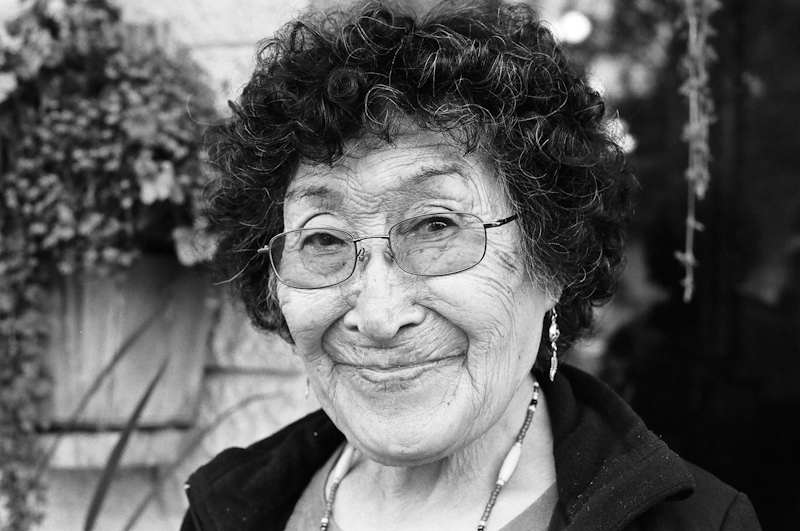
Grandmother Rita Pitka Blumenstein is a Yupik Elder and the first certified traditional doctor in Alaska. She is also an artist, a teacher, speaker and storyteller. Rita’s teachings of the “Talking Circle” have been recorded and published, and she’s traveled the world to teach song, dance, basket weaving and cultural issues. She donates these earnings to Native American colleges.
Grandmother Rita was born on a fishing boat. Because her father died before she was born, Rita was raised by mother, grandmothers and great-grandmothers. All were wise women elders of her Yupik people. “I grew up with the Grandmothers, walked with the grandmothers and learned with the grandmothers,” she said of her family’s powerful teachings.
Grandmother Rita’s family lived in Tununak on Alaska’s Nelson Island. The bitter cold and barren tundra made life hard for the Yupik, whose name means “Real People.” With no forests or trees, the Yupiks said special prayers for the return of the driftwood each year. They also prayed to the animal spirits for help.
Rita began learning while in her mother’s womb. “My mother taught me that her tummy was my first world, and whatever she did while I was in her was something I learned,” Grandmother Rita says. ” Being in the Mother’s womb is like being under the ice; unsure of the light and hearing things but not clearly.” From the time of her birth, the Yupik grandmothers recognized Grandmother Rita’s spiritual being and healing powers.
When she was a young child, Grandmother Rita had diphtheria for two years and could barely breathe. All she could do was listen. By age 9, she was already receiving visions and was working as a healer. In a recent vision, she saw people looking up at the sky in terror. It turned out to be 9-11.
Rita’s grandmothers stressed that school is important, but more important was learning about oneself. From a young age, Yupik youth are taught that when they think of something, they also need to feel it. And when they feel something, they also need to think about it. “It is essential to allow yourself to know what you know, instead of driving yourself to be,” she believes. “When there is so much striving to be and become, we don’t often recognize what it is we really want when it’s right there in front of us.”
School helped balance Grandmother Rita between two worlds. Yupik people struggled with U.S. policies that ended the tribe’sfishing and hunting rightsand forced their children to attend schools outlawing tribal languages and traditions. “I caught the tail end of the old ways,” said Grandmother Rita. She believes her name, ” Tail End Clearing of the Pathway to the Light” reflects her mission to heal. “Theceremonies,the Potlach are old ways. I can see now, today, that all that happened back then was for this purpose, for this life we are living today. It was for my work now. The ceremonies were about what all our ancestors were doing for the future, for future use. We just didn’t know back then that meant today.”
Grandmother Rita was married happily and peacefully to a Jewish man for over 40 years. During those years, they had six children but five died. Today their living daughter jokingly calls herself a “Jeweskimo.”
In 1995, Grandmother Rita learned she had cancer. The cancer helped Rita recognize her lifetime of anger and sadness from not having a father. She knew she had to heal at the deepest levels. “Emotions become physical, and the physical becomes emotional. Healing is about peeling,” she says. “God said there is only abundance, and the only way through is to forgive. Holding on to negative emotions becomes caner or another illness. Our healing is not just for ourselves, it is for the universe. We forget who we are, and that is the cause of our illness.”
Today Grandmother Rita Blumenstein is a tribal doctor for the South Central Foundation. She uses plant and energy medicine to heal along with the wisdoms learned from her own grandmothers. “I really still don’t know what it is I do, and I don’t know after what I did,” she explains. “The secret is that I don’t know anything. I am your friend, I am not sick, not sad, not angry. But what about you?”
Grandmother Rita is also teaching her teen-age granddaughter — who “talks to Mother Earth” — to be a healerand carry on the traditions. She tells her granddaughter that the whole universe is for everyone’s use. Nothing is to be owned, only shared. “We are all here for the universe … Everything changes except the land we live on, and when that changes, we must accept it …When Mother Nature shows us she’s angry, that changes all of us. My Grandmother taught me long ago that you become a human being when you learn to accept., when you learn to let go. We are here for the universe.”
Inviting the grandmothers to come visit her in Alaska , Grandmother Rita said,” When people think of Alaska, they go, ‘Brrr.’ But I say, when you have a cold heart, that’s when you’re cold. When you have a warm heart, that’s when you are warm. Come to Alaska, and we’ll warm you up!”
Welcome! It is an honor to contribute and give another voice to the “The First Peoples” of our world.
Make No Bones About It. * KAOS 89.3 FM
Sundays 4pm to 6 pm with your Host, Raven Redbone.Visit KAOS 89.3 FM @ www.kaosradio.org!
Make No Bones About It
Make No Bones About It- Sound Cloud
World Peace and Prayer Day 2013
Encouraging Words from our Elders
"I appreciate your work in giving voice to our peoples. Blessings to you." Grandmother Mona Polacca
Quote of the Month
Yes, our life energy must be a gift for our future. Your life, my life, everybody’s life must follow your given path. So pray or meditate. Follow your inner path and learn just how powerful you are and learn that you are a leader for your people, your family, your children, and the Mother Earth.
-Chief Arvol Looking Horse, Lakota


 Grandmother Rita’s family lived in


 Make No Bones About It